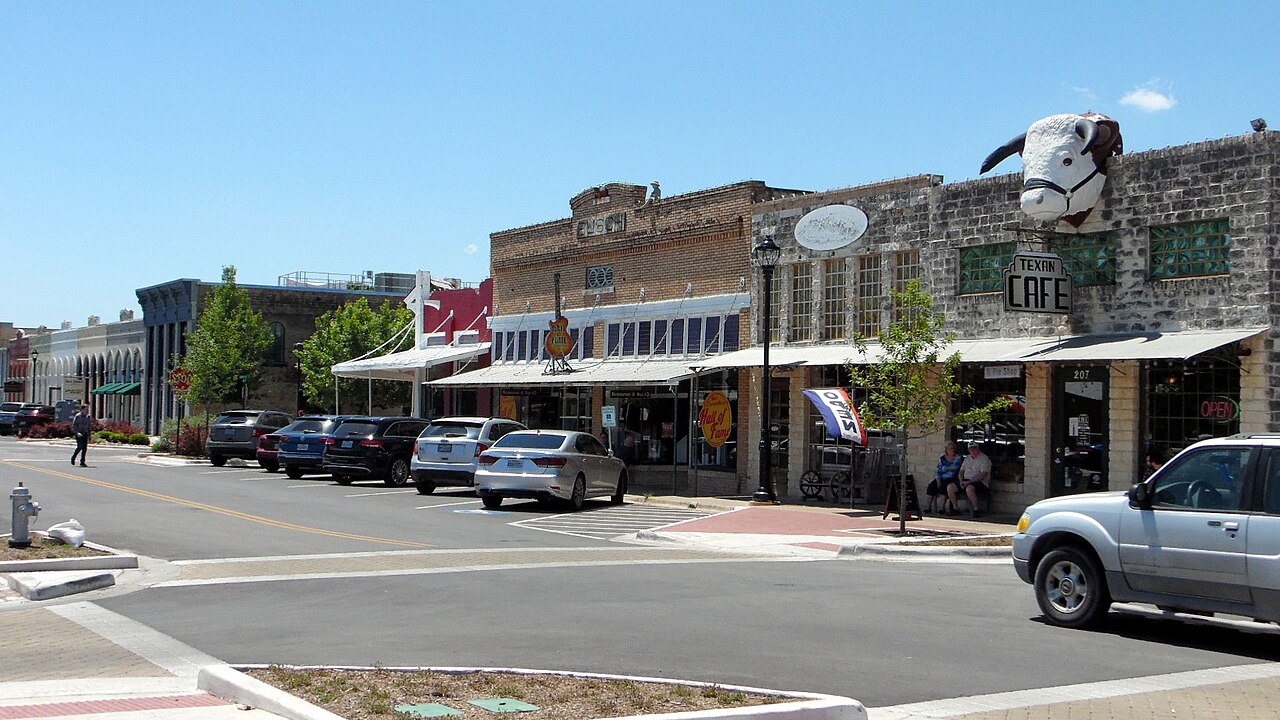
Downtown Hutto, Texas, one of the fastest-growing cities in the Austin area. Photo: KevinMoralesRealtor via Wikimedia Commons, CC0 public domain dedication.
Quick Answer: The Austin-Round Rock-San Marcos metro area reached 2,620,945 residents on July 1, 2025, a one-year gain of 53,796, according to U.S. Census Bureau estimates released in 2026. The city of Austin crossed 1 million for the first time, at 1,002,632, but grew just 0.4%, while Williamson County alone added 23,814 people.
Austin is now officially a city of more than 1 million people inside a metro area of more than 2.6 million. The Census Bureau’s Vintage 2025 estimates, published in March and May 2026, confirm that Central Texas is still one of the fastest-growing large regions in the country. They also show that the growth has moved outward. The city itself is adding residents slowly, and the suburbs, especially in Williamson County, are doing most of the growing. All figures are stated as of November 26, 2026, and reflect population on July 1, 2025, unless noted.
How many people live in the Austin metro area?
The five-county Austin-Round Rock-San Marcos metropolitan area had an estimated 2,620,945 residents on July 1, 2025. A year earlier the figure was 2,567,149. The gain of 53,796 people works out to growth of about 2.1%, or roughly 147 new residents a day.
Measured from the April 1, 2020, estimates base of 2,283,391, the metro has added 337,554 people, an increase of about 14.8% in a little more than five years.
How does Austin’s growth rank nationally?
Austin ranked sixth among all U.S. metro areas for numeric population growth between 2024 and 2025. Texas placed four metros in the top 10. Houston ranked first with a gain of 126,720, Dallas-Fort Worth second with 123,557, and San Antonio ninth with 38,402.
Austin’s rate of growth stands out more than its raw gain. U.S. metro areas as a group grew 0.6% over the year, down from 1.1% the year before, and 310 of 387 metros grew more slowly than they had a year earlier. Austin’s 2.1% was more than three times the national metro pace and, based on the Census figures, the fastest rate among the four large Texas metros.
| Metro area | U.S. rank by gain | Population, July 1, 2025 | One-year gain | Growth rate |
|---|---|---|---|---|
| Houston | 1 | 7,904,627 | 126,720 | About 1.6% |
| Dallas-Fort Worth | 2 | 8,477,157 | 123,557 | About 1.5% |
| Austin | 6 | 2,620,945 | 53,796 | About 2.1% |
| San Antonio | 9 | 2,813,140 | 38,402 | About 1.4% |
Growth rates calculated from Census Bureau totals. Source: U.S. Census Bureau, Vintage 2025 estimates.
Did Austin really pass 1 million residents?
Yes. The city-level estimates released May 14, 2026, put Austin’s population at 1,002,632, the first Census estimate above 1 million. Austin is the 12th most populous city in the United States and one of a dozen with at least 1 million residents. It sits behind Fort Worth, which ranks 10th at 1,028,117, and Jacksonville, Florida, at 1,017,689, and ahead of San Jose, California, at 989,814.
The milestone came with modest momentum. Austin added 4,025 residents over the year, an increase of 0.4%. That is about 7.5% of the metro area’s total gain. The city now holds roughly 38% of the metro population.
Why does the city think it passed 1 million earlier?
City Demographer Lila Valencia told FOX 7 Austin that the city believes Austin actually reached 1 million in 2020 and that the 2020 Census likely undercounted the city by about 40,000 people. The city’s own estimate for 2024 is 1,035,002, higher than the federal figure.
In its announcement, the City of Austin said international migration declined over the year, though less steeply than in other cities, that domestic migration contributed to growth, and that natural increase, meaning births minus deaths, was stable. The city did not publish figures for each component.
Where is the growth happening?
In the suburbs, and above all in Williamson County. The county north of Austin, home to Round Rock, Georgetown, Cedar Park, Leander and Hutto, had 752,827 residents on July 1, 2025, up 23,814 from 729,013 a year earlier. That gain ranked ninth among all U.S. counties and equals a growth rate of about 3.3%.
Put in perspective, Williamson County accounted for about 44% of the entire metro area’s population gain. It added nearly six times as many people as the city of Austin did. Since the 2020 base of 609,059, the county has grown by 143,768 people, or about 23.6%.
Caldwell County, southeast of Austin and centered on Lockhart, is far smaller but growing faster in percentage terms. Its population rose 4.2% to 55,150, from 52,939, making it the 10th-fastest-growing U.S. county among those with at least 20,000 residents. Caldwell has added 9,268 people, about 20.2%, since 2020.
| Area | April 2020 base | July 2024 | July 2025 | One-year change | Change since 2020 |
|---|---|---|---|---|---|
| Austin metro | 2,283,391 | 2,567,149 | 2,620,945 | +53,796 (2.1%) | +337,554 (14.8%) |
| Williamson County | 609,059 | 729,013 | 752,827 | +23,814 (3.3%) | +143,768 (23.6%) |
| Caldwell County | 45,882 | 52,939 | 55,150 | +2,211 (4.2%) | +9,268 (20.2%) |
Percentages calculated from Census totals. Travis, Hays and Bastrop counties did not appear in the Census Bureau’s national top-10 tables and are not shown. Source: U.S. Census Bureau.
Which Austin suburbs are growing fastest?
Hutto, in eastern Williamson County, grew 7.9% to 46,048 residents. That made it the 13th-fastest-growing U.S. city among those with at least 20,000 people, and the only Austin-area city on the Census Bureau’s top-15 list. The five fastest-growing cities in the country were all in Texas, led by Celina at 24.6%, but all five are in the Dallas-Fort Worth and Houston areas.
Valencia also said that Round Rock and Georgetown each added more residents than Austin over the period and that the suburbs are growing slightly faster than the city. No Austin-area city ranked in the national top 15 for numeric gain, a list that included Fort Worth, which added 19,512 people, and San Antonio, which added 14,359.
Is housing keeping up with population growth?
The housing estimates released alongside the city figures show that builders delivered a large number of homes. The Austin metro added 31,897 housing units between July 2024 and July 2025. That is about one new unit for every 1.7 new residents, a ratio, calculated from the Census figures, that shows home construction at least keeping pace with population growth in the latest year.
The location of those units differs from the location of the population growth. According to the City of Austin’s summary of the Census data:
| County | Share of 31,897 new units | Note |
|---|---|---|
| Travis | 51% | 16,197 units, up 2.4%; seventh-largest increase among U.S. counties |
| Williamson | 24% | About 44% of metro population gain |
| Hays | 17% | Ninth among U.S. counties for rate of housing growth |
| Bastrop | 6% | Not ranked nationally |
| Caldwell | 2% | Population up 4.2% |
Travis County, which includes most of Austin, captured about half of the region’s new housing. Williamson County captured about a quarter of the new housing but close to half of the new residents. One reasonable reading is that Travis County’s additions lean toward apartments, which house fewer people per unit, while Williamson County’s growth is driven by larger family households. The Census release does not break the units down by type.
Nationally, the housing stock reached 148.3 million units, up 1.4 million or 1.0% in a year. Texas has 12.8 million housing units, second to California’s 15 million. Harris County added about 28,000 units and Tarrant County about 18,000.
Is Austin’s growth slowing down?
The pace has cooled from the early 2020s, though comparisons across different Census vintages should be made with care, because the bureau revises earlier years each time it publishes. Under the prior Vintage 2024 estimates, the metro gained 58,019 people between 2023 and 2024 and ranked as the 25th-largest metro in the country, up from 28th at the start of the decade, Community Impact reported. It was the second-fastest-growing large metro in 2023 and the fourth-fastest in 2024.
The composition of growth has changed as well. For 2020 through 2024, the Vintage 2024 data showed domestic migration of 132,535, international migration of 71,200 and natural change of more than 63,000. But a March 2025 memo from Austin’s planning director said domestic migration had fallen to its lowest level in 15 years, making up just under a quarter of 2024 growth compared with a typical share of close to 60%, while international migration was at a record high.
That matters for the outlook. The Census Bureau reported that the national rate of net international migration fell from 8.08 to 3.70 per 1,000 residents in the latest year. A region that had come to depend more heavily on international arrivals is exposed to that decline, and the city’s statement that international migration fell locally is consistent with it.
How big will the Austin area get?
Long-range projections from the Texas Demographic Center, as published by the Austin Chamber, call for the metro to reach 2,918,491 residents in 2030, about 3.6 million in 2040, about 4.4 million in 2050 and 5,237,825 in 2060. Those 2022 projections assumed growth of 27.8% this decade.
| Area | 2030 | 2050 | 2060 |
|---|---|---|---|
| Austin metro | 2,918,491 | 4,371,108 | 5,237,825 |
| Travis County | 1,572,639 | 2,035,923 | 2,252,137 |
| Williamson County | 815,021 | 1,360,139 | 1,682,556 |
| Hays County | 356,181 | 721,388 | 1,031,309 |
| Bastrop County | 120,901 | 184,520 | 223,711 |
The 2025 estimate of 2,620,945 is already about 90% of the 2030 projection. To hit the 2030 figure, the metro would need to add roughly 297,500 more people in five years, or about 59,500 a year, somewhat above the latest annual gain of 53,796. Williamson County is running ahead of its projection. It needs about 62,000 more residents to reach its 2030 figure and added nearly 24,000 in the latest year alone. The projections also show Hays County passing 1 million residents by 2060.
What does this mean for Central Texas businesses?
For employers, retailers, health systems and developers, the data point in a consistent direction. Customer and workforce growth is concentrated north and east of the city, in Williamson County and in fast-growing towns such as Hutto. Site selection, store networks and clinic locations that follow rooftops will keep moving that way.
Inside Austin, the story is density more than headcount. Travis County is adding housing faster than it is adding people, which supports a deeper rental market and gives tenants more choice. For local governments, the split creates uneven pressure. Suburban counties face the cost of roads, schools and water service for tens of thousands of new residents a year, while the city manages big-city services on a population base that is barely growing.
Frequently Asked Questions
What is the population of the Austin metro area?
The Austin-Round Rock-San Marcos metro had 2,620,945 residents on July 1, 2025, according to U.S. Census Bureau Vintage 2025 estimates.
What is the population of the city of Austin?
The Census Bureau estimates 1,002,632 residents as of July 1, 2025, making Austin the 12th-largest U.S. city. The city’s own estimate is higher.
How fast is the Austin area growing?
The metro grew about 2.1% in the latest year, adding 53,796 people, the sixth-largest numeric gain among U.S. metros.
Which county near Austin is growing the most?
Williamson County added 23,814 residents to reach 752,827, the ninth-largest gain of any U.S. county. Caldwell County grew fastest by percentage, at 4.2%.
What is the fastest-growing city near Austin?
Hutto grew 7.9% to 46,048 residents, ranking 13th nationally among cities with at least 20,000 people.
How many homes were built in the Austin area?
The metro added 31,897 housing units between July 2024 and July 2025, with 51% in Travis County.
Sources and Further Reading
- Slow Growth Impacts Nation’s Largest Counties Hardest, U.S. Census Bureau
- Vintage 2025 City and Town Population and Housing Unit Estimates news release, U.S. Census Bureau
- Austin Population Milestone: One Million and Counting, City of Austin
- Austin Metro Grows to 25th Most Populous in US With More Than 2.5M Residents, Community Impact
- Greater Austin Profile: Population, Austin Chamber
- 1 Million: Austin Hits Population Milestone, Becomes 12th Largest City in U.S., FOX 7 Austin