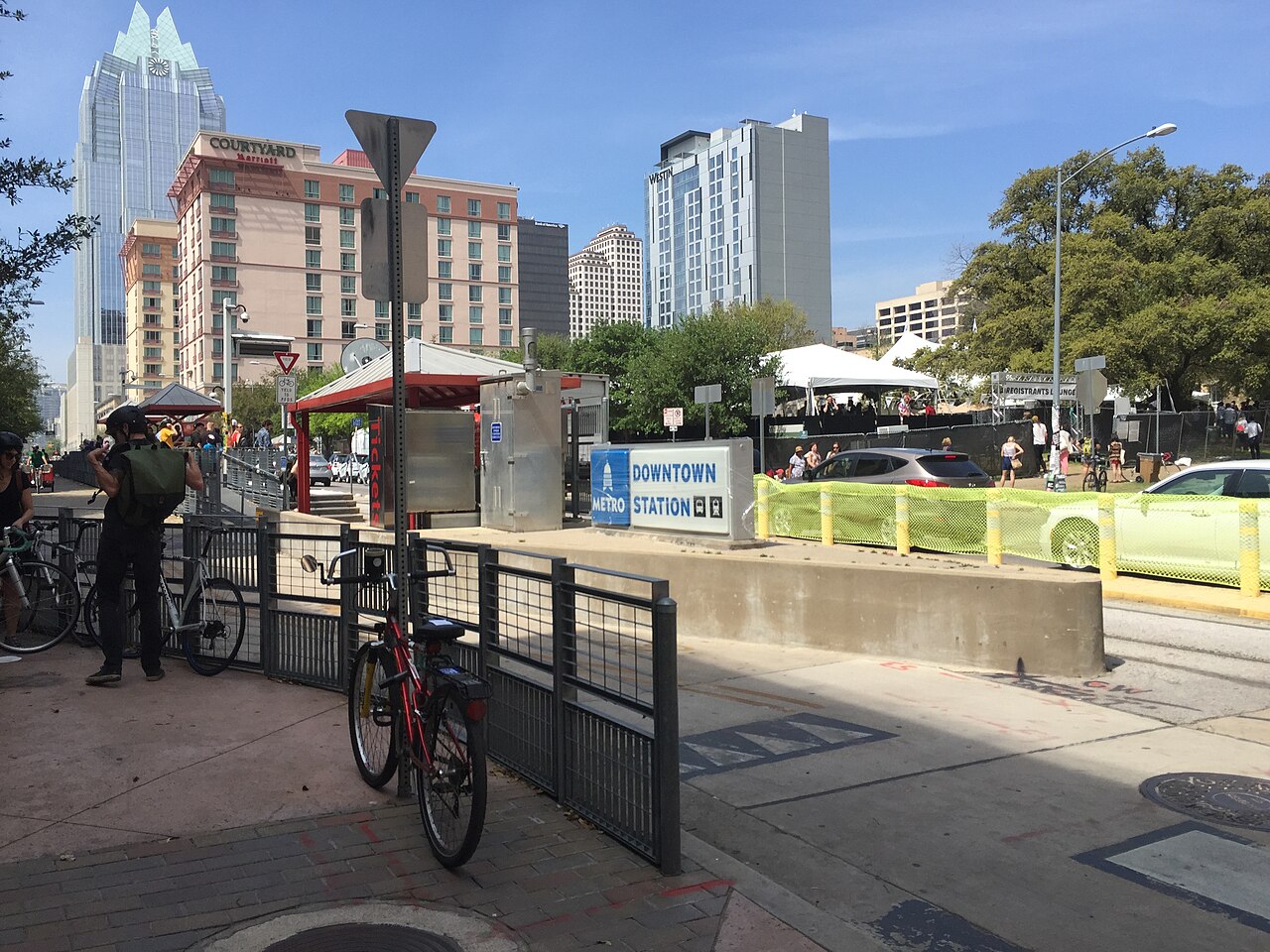
CapMetro Downtown Station in Austin, Texas. Photo: WhisperToMe via Wikimedia Commons, CC0 public domain dedication.
Quick Answer: CapMetro’s approved fiscal year 2027 budget totals about $701.5 million, with roughly $497 million for operations and $204.5 million for capital projects. The Austin transit agency is adding service hours and 93.5 positions while budgeting for ridership to fall to 24.2 million trips. Its first system-wide fare increase since 2015 takes effect January 10, 2027.
How big is CapMetro’s fiscal 2027 budget?
CapMetro plans to spend about $701.5 million in the fiscal year that began October 1, 2026 and runs through September 30, 2027. The approved budget document lists operating expenses of $496,962,382 and capital spending of $204,497,629. The operating figure is 10.8% above the fiscal 2026 budget of $448.3 million and well above fiscal 2025 actual spending of $436.6 million. The agency approved the budget in September 2026.
The largest operating cost is purchased transportation, the contracts under which outside companies operate much of the system. It is budgeted at $246.0 million, about half of all operating spending. Salaries and benefits total $105.9 million, up 12.5% from the prior budget. Fuel and fluids jump 56.3% to $24.2 million. The budget assumes diesel at $3.90 a gallon including taxes, compared with an average of about $2.45 in fiscal 2026, when hedging gains held costs down. As of July 2026, fiscal 2027 diesel purchases were not hedged.
| FY2027 funding source | Amount |
|---|---|
| Sales tax | $426.2 million |
| Use of fund balance | $116.8 million |
| Federal capital grants | $66.9 million |
| Operating contributions and grants | $45.3 million |
| Miscellaneous revenue | $22.2 million |
| Passenger revenue | $16.1 million |
| Freight railroad revenue | $6.8 million |
| Other capital contributions | $1.25 million |
| Total | About $701.5 million |
Source: CapMetro FY2027 Approved Operating and Capital Budget. Figures rounded.
Where does CapMetro’s money come from?
Sales tax pays for most of it. CapMetro budgets $426.2 million from its 1% sales tax in fiscal 2027, which is 3.9% above the fiscal 2026 forecast of $410.4 million and 6.8% above the fiscal 2026 budget. The rate is unchanged. By comparison, passenger fares are budgeted at $16.1 million. Sales tax brings in about 26 times as much as the farebox, which ties the agency’s finances far more closely to Austin-area retail spending than to how many people ride.
Federal money supports both sides of the budget. The operating budget includes $39.9 million in Federal Transit Administration Section 5307 formula funds plus $3.4 million in other federal operating reimbursements. The capital budget counts on $66.9 million in federal grants. CapMetro also earns $6.8 million from the freight railroad it owns, which Watco Companies operates.
The agency will draw $116.8 million from its fund balance to cover the year, an amount larger than its federal capital grants. Even so, it projects ending fiscal 2027 with $328.5 million in reserves. That includes a statutory operating reserve of about $81.9 million, a budget stabilization reserve of about $41.0 million, about $39.2 million dedicated to Project Connect and about $147.5 million set aside for the five-year capital plan. CapMetro reported no outstanding debt as of July 2026.
Why is ridership expected to fall?
CapMetro’s own budget forecasts a second consecutive annual decline. The agency carried 26.65 million trips in fiscal 2025, forecasts 25.32 million for fiscal 2026 and budgets 24.18 million for fiscal 2027. That is a drop of about 5% in the first year and about 9% across two years. The budget document states that the January fare increase is expected to reduce ridership.
| Mode | FY2025 actual | FY2026 forecast | FY2027 budget |
|---|---|---|---|
| Bus | 18,969,976 | 17,242,677 | 15,885,608 |
| Rapid | 4,202,957 | 4,574,954 | 4,772,989 |
| UT Shuttle | 1,140,315 | 1,066,741 | 1,026,390 |
| Access (paratransit) | 615,810 | 649,700 | 685,433 |
| Rail | 608,523 | 648,597 | 614,478 |
| Pickup | 571,200 | 575,348 | 575,348 |
| Vanpool | 385,821 | 398,539 | 451,979 |
| Express | 148,850 | 151,053 | 152,988 |
| Total, including special events | 26,649,156 | 25,318,275 | 24,177,336 |
Source: CapMetro FY2027 Approved Operating and Capital Budget.
Which services are gaining riders and which are losing them?
The decline is concentrated in local bus service. Bus trips are budgeted to fall about 16% between fiscal 2025 and fiscal 2027, from 18.97 million to 15.89 million. Rapid, the agency’s limited-stop, high-frequency bus network, moves the other way, rising about 14% to 4.77 million. Access paratransit and vanpool are also budgeted to grow. Some of the local bus decline likely reflects riders shifting to the two new Rapid lines that run in the same corridors, though the budget does not quantify that.
Independent data show the same direction. The American Public Transportation Association’s second-quarter 2026 report shows CapMetro with about 12.5 million unlinked trips from January through June 2026, down 4.82% from 13.1 million in the same months of 2025. Bus trips were down 5.48%, while commuter rail rose 1.65%, demand response rose 3.15% and vanpool rose 1.73%. Average weekday ridership was about 77,400. As of a July 2025 board presentation reported by the Austin Monitor, ridership remained about 20% below its 2019 high.
Is CapMetro cutting service?
No. Service is growing while ridership shrinks. Total vehicle hours rise from 2.18 million in fiscal 2025 to a budgeted 2.37 million in fiscal 2027. Rapid hours climb from 255,270 to 373,379 and Rapid miles from 3.3 million to nearly 4.7 million. The budget funds a full year of 10-minute frequency on both new Rapid lines, up from 20 minutes.
What changes with fares in January 2027?
CapMetro’s board approved a two-step fare increase on September 28, 2026. The first step takes effect January 10, 2027 and the second in January 2029. It is the first system-wide increase since 2015. CapMetro says fares cover about 4% of system operating costs, compared with an industry average of 13% to 14%.
| Fare | Now | Jan. 10, 2027 | January 2029 |
|---|---|---|---|
| Local single ride | $1.25 | $1.50 | $2.00 |
| Local day cap | $2.50 | $3.00 | $4.00 |
| Local monthly cap | $41.25 | $49.50 | $66.00 |
| Commuter single ride (rail, express) | $3.50 | $4.00 | $5.00 |
| Commuter monthly cap | $96.25 | $110.00 | $137.50 |
| Access single ride | $1.75 | $2.25 | $3.25 |
The Equifare program is being eliminated, and its enrollees move to Reduced Fare, a 50% discount that covers riders 65 and older, Medicare card holders, military members and veterans, riders with disabilities and households at or below 150% of the federal poverty level. Ticket vending machines are being removed from bus stations and transit centers, with one kept at each rail station.
Why is CapMetro bringing rail operations in-house?
CapMetro will move commuter rail operations, dispatch and vehicle maintenance from a contractor to its own staff in January 2027. The change converts about 88 full-time positions and is the main reason budgeted headcount rises to 758.5 full-time equivalents from 665.0, an increase of 93.5. The budget also adds seven transit police officers.
The accounting shifts with it. About $15 million in maintenance-of-way and signal costs moves from purchased transportation to professional services, including roughly $4.5 million in one-time transition costs, and rail purchased transportation falls a net $13.5 million. The rail commuter operations department budget rises to $35.4 million from $24.3 million. Rail remains the agency’s costliest fixed-route service per rider: through the third quarter of fiscal 2026, cost per rail trip was $53.12, against $12.62 for bus.
What is CapMetro building?
The fiscal 2027 capital budget of $204.5 million is split among bus projects at $74.7 million, Access and Pickup at $64.9 million, rail at $40.6 million, shared agency assets at $21.1 million, public safety at $2.4 million and bikeshare at $814,000. Local funds cover $136.3 million and grants $66.9 million. The five-year capital plan for fiscal 2027 through 2031 totals $646.9 million.
Named projects include the North Base Demand Response Facility, supported by a $20 million federal Section 5339(b) grant, with construction in 2026 and 2027; site development for a South Base demand response facility; and double-tracking of the commuter rail line in East Austin, supported by an $18 million federal BUILD award. The fleet stands at 372 diesel buses, 104 electric buses and 10 rail vehicles. The capital plan includes money to return part of the electric bus fleet to service.
What is the status of the new Rapid lines?
Both lines are open at full planned service. Rapid 800 on Pleasant Valley and Rapid 837 to the Expo Center were first introduced in February 2025, and CapMetro marked their full launch on June 15, 2026. The lines added 79 stations and two park-and-ride lots with end-of-line electric bus charging: Expo Center with 159 spaces and Goodnight Ranch with 64. CapMetro describes the lines as its eighth completed project under Project Connect, the voter-approved transit program whose light rail component is being built by the separate Austin Transit Partnership. CapMetro’s fiscal 2027 contribution to Project Connect is $30.0 million, up from $21.9 million.
How does cost per trip compare across CapMetro services?
Cost per passenger varies widely by mode, and two of four services missed their targets in the latest reported period. Through the third quarter of fiscal 2026, a bus trip cost $12.62 against a target of $11.07 or less, and a Pickup on-demand trip cost $33.58 against a target of $23.20. Rail, at $53.12, came in under its $61.74 target, and Access paratransit, at $108.44, came in under its $130.75 target. On-time performance was 92.2% for rail, 92.5% for Access and 86.7% for Pickup. In the fiscal 2027 budget, bus transportation is the largest department at $177.0 million, followed by demand response oversight at $55.0 million, with microtransit at $9.8 million and vanpool at $3.5 million. CapMetro projects 206 vanpools by the end of the fiscal year.
What service changes took effect in 2026?
The most recent change came on August 16, 2026. Route 2 was extended along Springdale Road as a two-way loop, Route 217 moved to Vargas Road and no longer serves the Austin Community College Riverside campus, and Route 985 began using new toll lanes on U.S. 183. Weekday frequency on UT Shuttle routes 661 and 670 was reduced from every eight to 10 minutes to every 15 to 20 minutes, and schedules were adjusted on 15 routes. Under Transit Plan 2035, items planned within five years include bus route improvements, a new North Burnet/Uptown rail station and extended rail hours. More than 10,000 people took part in developing the plan.
Who governs and funds CapMetro?
CapMetro serves Austin, Jonestown, Lago Vista, Leander, Manor, Point Venture, San Leanna, Precinct Two of Travis County and the Anderson Mill area of Williamson County. Each member dedicates 1% of local sales tax to the agency by voter approval. The service area covers about 549 square miles and more than 1.3 million residents, according to the budget. Travis County Commissioner Jeffrey Travillion chairs the board, and Dottie Watkins is president and chief executive. The board adopted Transit Plan 2035 on October 20, 2025, a service blueprint being rolled out through three service changes a year beginning in 2026.
What does this mean for Austin employers and commuters?
For employers, the practical changes are higher commuter costs and more frequent service on key corridors. A local monthly cap rises from $41.25 to $49.50 in January, and a commuter monthly cap from $96.25 to $110.00, which affects companies that subsidize passes. Workers along Pleasant Valley and the Expo Center corridor now have 10-minute Rapid service. For taxpayers, the agency’s dependence on sales tax means its budget tracks the regional economy. Its performance data also show room to improve: on-time performance for bus, Rapid and Express was 77.1% against an 80% target through the third quarter of fiscal 2026, and year-to-date ridership of 18.7 million was below a 20.4 million target.
Frequently Asked Questions
How much is CapMetro’s fiscal 2027 budget?
About $701.5 million, made up of roughly $497 million in operating expenses and $204.5 million in capital spending.
When do CapMetro fares go up?
January 10, 2027. A local single ride rises from $1.25 to $1.50, and a commuter single ride from $3.50 to $4.00. A second increase follows in January 2029.
How many people ride CapMetro?
The agency recorded 26.65 million trips in fiscal 2025 and budgets 24.18 million for fiscal 2027. Average weekday ridership in the first half of 2026 was about 77,400.
How is CapMetro funded?
Mostly by a 1% sales tax in member jurisdictions, budgeted at $426.2 million in fiscal 2027. Fares are budgeted at $16.1 million.
Does CapMetro have debt?
The agency reported no outstanding debt as of July 2026 and projects $328.5 million in reserves at the end of fiscal 2027.
Sources and Further Reading
- FY2027 Approved Operating and Capital Budget, CapMetro
- Financial Transparency and Information, CapMetro
- Public Transportation Ridership Report, Second Quarter 2026, American Public Transportation Association
- New Fares Effective January 10, 2027, CapMetro
- CapMetro and Community Leaders Celebrate Rapid 800 and 837 Launch, June 15, 2026, CapMetro
- CapMetro Board of Directors Approves Transit Plan 2035, October 20, 2025, CapMetro
- Approved August 2026 Service Changes, CapMetro
- CapMetro shares ridership numbers, August 2025, Austin Monitor
- Capital Metro fares to increase in 2027 and 2029, September 2026, Community Impact