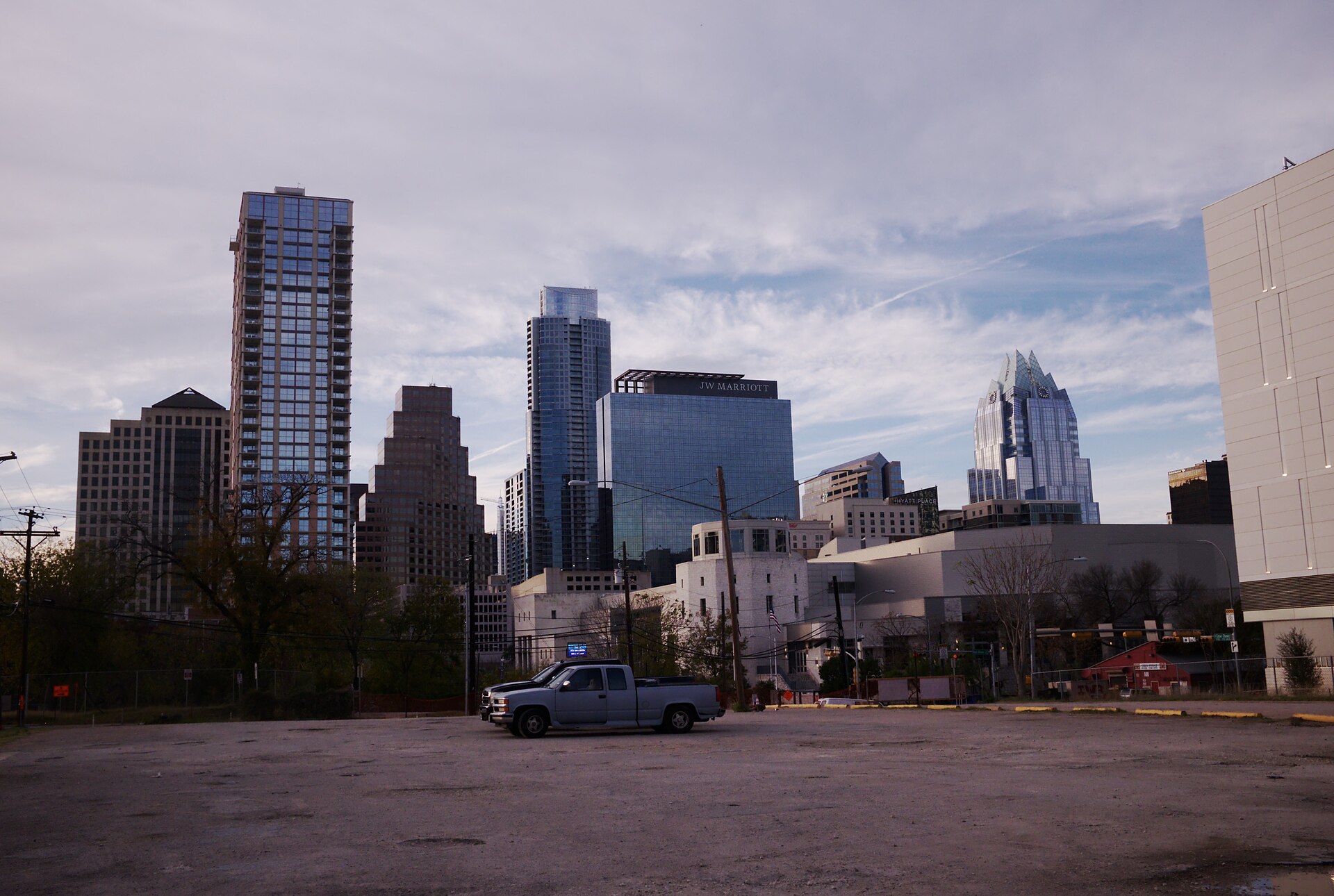
Image: Wikimedia Commons, P01 Austin, Texas 42.jpg (CC0).
Quick Answer: The Texas Department of Transportation is rebuilding Interstate 35 through the middle of Austin under the I-35 Capital Express Central project, which the agency estimates at about $4.5 billion and expects to complete in 2033. Work began in October 2024 and is divided into six construction segments, including 6.5 miles of 22-foot-diameter drainage tunnels. Two companion projects to the north and south, estimated at $606 million and $548 million, are already under construction.
What is the I-35 Capital Express program?
I-35 Capital Express is the Texas Department of Transportation’s plan to rebuild 28 miles of Interstate 35 through the Austin area, from State Highway 45 North to State Highway 45 Southeast. It is part of the agency’s wider Mobility35 program, which covers 79 miles of the corridor. TxDOT has split the Austin work into three projects, North, Central and South, and all three are designated Texas Clear Lanes projects, the state initiative aimed at its most congested roadways.
The Central project is by far the largest and the most complicated. It runs from US 290 East to State Highway 71, also known as Ben White Boulevard, and passes the University of Texas campus, the State Capitol complex, downtown and Lady Bird Lake. TxDOT’s project materials say funding comes from state and federal gas and tax money, and the agency does not plan tolls on the new lanes.
| Project | Limits | Estimated cost | Managed lanes | Timeline |
|---|---|---|---|---|
| North | SH 45 North to US 290 East | $606 million | One each direction, non-tolled | 2023 to 2029 |
| Central | US 290 East to SH 71/Ben White Blvd. | About $4.5 billion | Two each direction, non-tolled | 2024 to 2033 |
| South | SH 71/Ben White Blvd. to SH 45 Southeast | $548 million | Two each direction, non-tolled | 2022 to 2028 |
How much will the Central project cost?
TxDOT’s project FAQ, the City of Austin’s project page and the Texas Clear Lanes project list all put the Central project at about $4.5 billion. The agency cautions that the figures are estimates and are subject to change as each phase of the project goes under contract.
Readers will also see a $5.6 billion figure. TxDOT’s October 31, 2024, groundbreaking news release cited $5.6 billion for the Central project, and the City of Austin’s page says the long-term Capital Express projects are estimated to total $5.6 billion. The three individual estimates, $606 million, about $4.5 billion and $548 million, add up to roughly $5.65 billion, which suggests the larger number is best read as the program total rather than the Central project alone.
TxDOT explains why Central costs several times more than the other two projects combined: the improvements are more extensive, the corridor runs through a constrained urban area, and the work presents constructability challenges. The agency also notes that the Downtown segment and the drainage tunnel are funded by TxDOT and the Capital Area Metropolitan Planning Organization.
What exactly is being built through central Austin?
The project is a reconstruction, not a simple widening. According to TxDOT’s project page and groundbreaking release, the main elements are:
- Two non-tolled high-occupancy vehicle managed lanes in each direction from US 290 East to SH 71.
- Removal of the existing upper decks and lowering of the main lanes. The groundbreaking release describes the lowered section as running from Airport Boulevard to Lady Bird Lake.
- Boulevard-style frontage roads through downtown.
- Widened and rebuilt east-west crossings, including Airport Boulevard, 38 1/2 Street, 32nd Street, Dean Keeton Street, Manor Road, and 15th, 12th, 11th, 7th, 6th, 5th, 4th and Cesar Chavez streets.
- More than 19 miles of new shared-use paths for pedestrians and cyclists.
- Vehicle bypass lanes at 28 intersections.
- Thirteen connections to the urban trail and bicycle network, plus a new bicycle and pedestrian crossing at Lady Bird Lake.
One number differs between TxDOT documents. The project page and the groundbreaking release cite more than 19 miles of shared-use paths, while the FAQ refers to 16.6 miles in construction or design. The lists of new bicycle and pedestrian crossings also vary slightly from document to document, which is typical of a project still completing design on its later segments.
What are the six construction segments?
TxDOT is building the Central project in pieces, each under its own contract. The agency’s schedule graphic, labeled tentative as of June 11, 2026, gives the following timelines.
| Segment | Limits or scope | Contractor | Timeline |
|---|---|---|---|
| Martin Luther King Jr. Boulevard | Reconstruction of the MLK Jr. Blvd. bridge | Harper Brothers | 2024 to 2026 |
| Lady Bird Lake | Holly Street to SH 71/Ben White Blvd. | Balfour Beatty | 2025 to 2033 |
| Drainage Tunnel and Pump Station | Airport Blvd. to Holly Street, and along Cesar Chavez Street to US 183 | SAK/Shea joint venture (tunnel); Webber Waterworks (pump station) | 2025 to 2029 |
| CapMetro Bridges | Rail bridge work | Not listed | Not listed |
| University | US 290 East to MLK Jr. Blvd. | Not listed | 2027 to 2033 |
| Downtown | MLK Jr. Blvd. to Holly Street | Not listed | 2027 to 2033 |
Which segments are already under way?
Construction started in October 2024 with the reconstruction of the Martin Luther King Jr. Boulevard bridge, a contract held by Harper Brothers. The Lady Bird Lake segment, from Holly Street to SH 71, was slated to follow in early 2025 under Balfour Beatty. The drainage tunnel work began in May 2025.
When do the downtown and university segments start?
The two segments that will most affect daily life in the urban core come later. TxDOT’s schedule graphic shows both the University segment and the Downtown segment running from 2027 to 2033. An undated TxDOT fact sheet for the Downtown segment gives an anticipated construction start of 2026, so the more recent schedule appears to have moved that start back. TxDOT has not listed contractors or contract values for either segment in the materials reviewed.
Why does the project need 6.5 miles of tunnels?
Lowering a highway below the surrounding streets creates a place for stormwater to collect. TxDOT’s answer is one of the larger underground projects in the city’s history: 6.5 miles of drainage tunnels 22 feet in diameter.
According to a TxDOT construction information sheet dated September 26, 2025, the tunnels run beneath I-35 between Airport Boulevard and Holly Street and along Cesar Chavez Street from I-35 to US 183. The system includes a pump station and a series of access and drop shafts at locations such as Airport Boulevard, Hancock Center, 15th Street, 11th Street and the Cesar Chavez and I-35 intersection.
The work is organized in four phases, with the launch of tunnel boring machines in the third. The tunnel contractor is a joint venture of SAK and Shea, and Webber Waterworks is building the pump station. Work started in May 2025 and the schedule graphic shows the tunnel and pump station finishing in 2029, four years ahead of the highway itself. That sequencing matters: the drainage system has to be in place before the lowered main lanes can open.
How congested is I-35 through Austin today?
The case TxDOT makes for the project rests on a handful of statistics.
| Measure | Figure | Source cited |
|---|---|---|
| Daily vehicle trips | Nearly 200,000, about 85% local to the region | City of Austin |
| Statewide congestion rank | Third most congested highway segment in Texas | Texas A&M Transportation Institute, 2024 list |
| Average commuter delay | 66 hours per year | TTI 2019 Mobility Report, per TxDOT |
| Annual congestion cost per commuter | $1,269 in fuel and delay | TxDOT FAQ |
| Regional population outlook | Expected to double by 2045 | TxDOT FAQ |
The 85 percent figure is the one that most shapes the debate. I-35 is an international trade route, but the City of Austin’s project page says the large majority of trips on the Austin section begin or end within the region. That is the basis for the managed lane design, which gives priority to buses and vehicles carrying multiple people rather than adding general-purpose lanes.
What are the caps and stitches, and who pays for them?
Because the main lanes will sit below street level through much of the core, it becomes possible to build decks over the highway. A cap is a larger deck that can hold a park or plaza; a stitch is a widened bridge with room for more than a sidewalk. The City of Austin’s effort to plan them is called Our Future 35.
TxDOT’s materials lay out a clear division of responsibility. The agency says it is working with the City of Austin and the University of Texas on conceptual design, and that the city and the university will determine the locations and fund operations and maintenance of the caps for the life of the project. TxDOT builds the highway infrastructure and the fire-suppression systems that covered sections require.
The FAQ lists four areas recommended for evaluation as deck plazas: Airport Boulevard to 38 1/2 Street, Manor Road to Martin Luther King Jr. Boulevard, 12th Street to 11th Street, and 7th Street to Cesar Chavez Street. The TxDOT and city pages reviewed for this article do not state dollar amounts or funding deadlines for the caps, so those details are not reported here.
What does the project mean for Austin businesses?
Several practical points follow from the verified schedule and scope.
The disruption is long and staggered. With the Lady Bird Lake segment scheduled through 2033 and the University and Downtown segments scheduled from 2027 to 2033, businesses near the corridor are looking at construction for most of the next seven years. TxDOT’s FAQ puts the Central construction period at six to eight years.
Cross streets are being rebuilt, not just the highway. Fourteen named east-west crossings are on the reconstruction list, including 4th through 7th streets downtown. For retailers, restaurants and hotels on either side of the highway, access during those bridge replacements will matter as much as main lane closures.
The contracts are large and still being awarded. Only the MLK bridge, Lady Bird Lake and drainage segments have named contractors in TxDOT’s published materials. The University and Downtown segments, which cover the densest stretch, are still ahead.
The other two projects finish first. Texas Clear Lanes lists the South project, with two managed lanes in each direction, for 2022 to 2028, and the North project, with one managed lane in each direction, for 2023 to 2029. Commuters from Hays and Williamson counties should see those sections completed years before the downtown work is done. TxDOT’s groundbreaking release said construction along the entire corridor is expected to be complete in 2033, weather permitting.
Frequently Asked Questions
How much does the I-35 Capital Express Central project cost?
TxDOT estimates the Central project at about $4.5 billion and says estimates may change as each phase goes under contract. The three Capital Express projects together total roughly $5.6 billion.
When will I-35 construction in Austin be finished?
TxDOT expects construction along the corridor to be complete in 2033, weather permitting. The South project is scheduled through 2028 and the North project through 2029.
Will the new I-35 lanes be tolled?
No. TxDOT describes the added lanes as non-tolled high-occupancy vehicle managed lanes, two in each direction on the Central and South projects and one in each direction on the North project.
Are the upper decks being removed?
Yes. The Central project removes the existing upper decks and lowers the main lanes through the core of the city.
How long are the I-35 drainage tunnels?
TxDOT’s plans call for 6.5 miles of drainage tunnels, 22 feet in diameter, plus a pump station. The work began in May 2025 and is scheduled to run through 2029.
Who pays for the caps over I-35?
TxDOT says the City of Austin and the University of Texas will determine cap locations and fund their operations and maintenance, while TxDOT builds the supporting highway infrastructure.
Sources and Further Reading
- I-35 Capital Express Central Project – Texas Department of Transportation
- TxDOT Breaks Ground on Transformational I-35 Capital Express Central Project – Texas Department of Transportation
- Capital Express Central Downtown Segment Fact Sheet – Texas Department of Transportation
- Capital Express Central Drainage Tunnel Construction Information – Texas Department of Transportation
- Mobility35 Frequently Asked Questions – Texas Department of Transportation
- Texas Clear Lanes: Austin Projects – Texas Department of Transportation
- City of Austin and I-35 Capital Express Projects – City of Austin