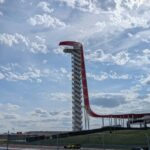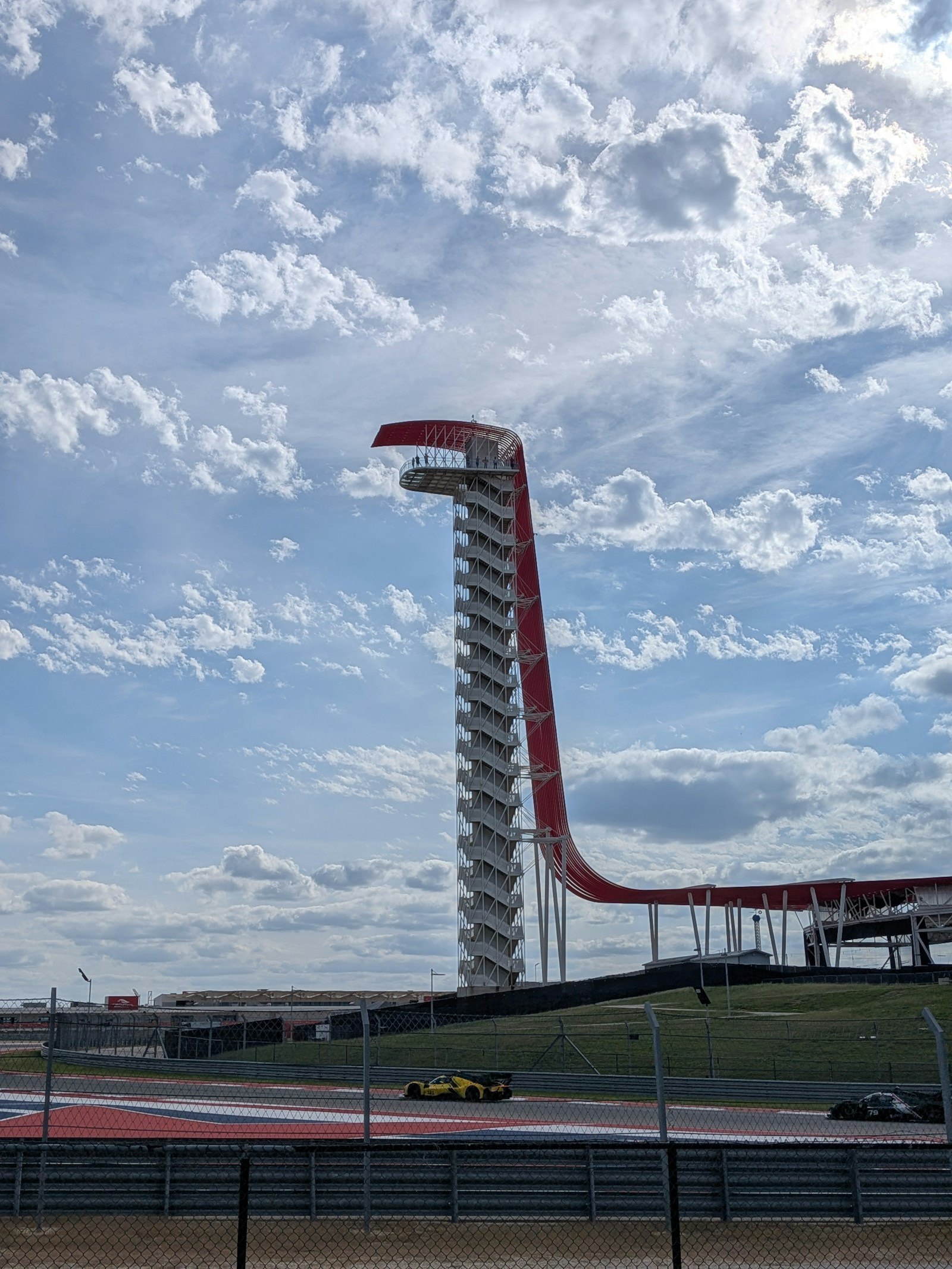
The observation tower at Circuit of the Americas in Del Valle. Photo: Sai Kiran Belana on Unsplash, Unsplash License.
How many people attended the 2026 United States Grand Prix?
Formula 1 put three-day attendance at 467,000 for the race weekend that ended Sunday, October 25, 2026, a record for the event. Mercedes driver Kimi Antonelli won from pole position. The total passed the previous verified high of 440,000 set in 2022.
The track’s chairman, Bobby Epstein, told reporters that ticket sales were deliberately stopped and that selling another 25,000 would have caused problems. The limit is roads, not seats. Epstein has said he expects attendance to pass 500,000 once nearby highway expansions are finished, work he described as scheduled within two years, and that the improvements could add 15,000 to 30,000 people a day.
| Race year | Three-day attendance | Note |
|---|---|---|
| 2021 | 400,000 | Then a record for any F1 race in North America |
| 2022 | 440,000 | Record at the time |
| 2023 | 432,000 | First sprint weekend in the United States |
| 2026 | 467,000 | Record, per Formula 1 |
Weekend totals for 2024 and 2025 were not confirmed in the sources reviewed for this article. Formula 1 said in October 2025 only that recent editions had drawn more than 430,000. For context, the series reported 3.7 million in total attendance across the first 11 races of 2026, up 6%, with the British Grand Prix drawing 564,000.
The path to the record was not a straight line. Attendance slipped by 8,000 in 2023, the first year the weekend used the sprint format, and Epstein linked the dip to Saturday’s schedule. A year later he told Autosport he expected sprint Saturday to draw 130,000 to 150,000, and the track enlarged its infield lawn to hold close to 100,000 people for a 2024 concert by Eminem.
Where do the fans come from?
Mostly from outside Texas. Visit Austin says about 70% of F1 fans travel from out of state or abroad. The Governor’s Office post-event report for the 2021 race estimated 93,296 out-of-state attendees, or 68% of the total. That mix is what makes the event valuable to hotels and to the state’s tax-based incentive formula, because visitor spending is new money to the Texas economy.
How long is Formula 1 committed to Austin?
Formula 1 announced on October 19, 2025, that the United States Grand Prix will stay at Circuit of the Americas through the 2034 season. Financial terms were not disclosed. ESPN describes the extension as the track’s longest yet.
COTA opened in 2012 as the first purpose-built F1 venue in the United States. The circuit is 5.5 kilometers long with 20 turns and sits on 1,500 acres in Southeast Austin. Formula 1 says the race generated $7 billion in economic impact for Austin and Texas in its first decade.
| Key fact | Detail |
|---|---|
| Opened | 2012 |
| Property | 1,500 acres in Southeast Austin |
| Circuit | 5.5 kilometers, 20 turns |
| F1 contract | Through 2034 season |
| 2026 attendance | 467,000 over three days |
| Chairman | Bobby Epstein |
| COTALAND opening | September 25-27, 2026 |
| Planned hotel | 1,000 rooms |
How much state money supports the race?
The race has been supported since its first year by Texas event trust funds, which reimburse organizers after an event from the additional state and local tax revenue the event is projected to generate. The state’s contribution is capped at the projected gain in state sales, auto rental, hotel and alcoholic beverage taxes. Local governments put up $1 for every $6.25 of state money.
The applicant each year is the Circuit Events Local Organizing Committee, and the site selection organization is Formula One Management. The program moved from the Texas Comptroller to the Governor’s Office on September 1, 2015.
| Race | State share | Local share | Trust fund established | Primary direct spending |
|---|---|---|---|---|
| 2017 | $23,416,272 | $3,746,604 | $27,162,876 | $247,300,865 |
| 2019 | $23,116,616 | $3,698,659 | $26,815,275 | $251,049,167 |
| 2021 | $30,633,797 | $4,901,408 | $35,535,205 | $331,449,986 |
Those figures, from Governor’s Office post-event reports, show the size of the trust fund established for each race, not necessarily the amount disbursed. The one confirmed payment in the sources reviewed is from the inaugural race, when the Comptroller paid organizers $29.3 million in December 2012 to cover the F1 sanctioning fee, temporary seating and shuttle bus operations. Front Office Sports reported that COTA collected nearly $200 million in state reimbursements between 2012 and 2020.
The Governor’s Office program page lists no F1 post-event reports after 2021, so trust fund amounts for the 2022 through 2026 races could not be verified. Statewide, the program approved 161 applications in fiscal 2024, according to preliminary figures.
What is the race worth to the Austin economy?
It depends on who is counting and how. The estimates below use different methods and should not be compared directly.
| Estimate | Source | Year |
|---|---|---|
| $331.4 million in primary direct spending | Office of the Texas Governor | 2021 |
| More than $470 million across hotels, food, drink, retail and rental cars | City of Austin data, reported by KUT | 2024 |
| More than $1 billion in direct and indirect spending; $38 million in state tax receipts | Formula 1 | 2023 |
| More than $1 billion, about half from direct spending (projection) | Visit Austin, via City of Austin | 2026 |
The state’s 2021 report offers the most detailed breakdown. Of $331.4 million in direct spending, hotels and motels accounted for $154.7 million, shopping and entertainment $58.0 million and eating and drinking $53.5 million. Estimated average daily attendance was 136,841, above the 129,987 required under the trust fund agreement.
The City of Austin said in an October 26, 2026, statement that final results for this year’s race will take time to measure.
The race sits inside a much larger visitor economy. Visit Austin counts roughly 30 million visitors a year, an $11.1 billion visitor economic impact and about 148,000 hospitality and tourism jobs citywide. In the state’s earlier reports, hotel and motel spending tied to the race was $80.6 million in 2017 and $73.8 million in 2019, about half the 2021 figure.
What does race weekend do to Austin hotels?
Visit Austin expected hotel occupancy of 92% to 95% during the 2026 event period. Axios reported that citywide occupancy tops 95% on race weekend, with mid-range to upscale rooms averaging $700 to $800 a night. Data firm Deckard Technologies found 90% of short-term rentals booked for the weekend, compared with 46% on a normal fall weekend.
Historical data points in the same direction. CoStar figures cited by the city show that upper-tier Austin hotels ran 91% occupancy at a $676 average daily rate during the 2022 race, producing about $29 million in room revenue over three days. In the state’s 2021 report, Travis County hotel occupancy tax collections were $6.68 million in November 2021, compared with $2.34 million in November 2020, a month affected by the pandemic and without a race.
The 2026 weekend was unusually crowded. It overlapped with a Texas home football game against Ole Miss on Saturday and a Spurs-Rockets game at Moody Center on Friday. Visit Austin says October brings in more hotel revenue and hotel occupancy tax than any other month. Austin-Bergstrom International Airport screened 45,048 departing travelers on the Monday after the 2025 race, a single-day record at the time.
What else is being built at COTA?
What is COTALAND?
COTALAND, a 30-acre amusement park beside Turns 19 and 20, held its grand opening weekend September 25-27, 2026, after five years of development. It has more than 30 attractions, including Circuit Breaker, a Vekoma tilt coaster that is the second of its kind in North America, and Palindrome, a Gerstlauer coaster that reaches 95 feet and 51 miles per hour.
KUT reported that the park is expected to employ about 1,300 people and eventually draw 1.5 million visitors a year. Single-day tickets ranged from $39.99 to $75 at opening, with annual passes from $199. The opening was not flawless. Circuit Breaker stopped twice with riders aboard during the first weekend, once for about nine minutes, with no injuries reported.
The park changes the business model. A race track earns most of its revenue on a handful of weekends. An amusement park that operates through the year gives the property a steadier base of visitors and employees.
What is the hotel plan?
A 1,000-room hotel and convention project is planned next to the track by Houston-based RIDA Development Corp. The Austin City Council voted on July 24, 2025, to accept about 21 acres at no cost. The developer leases the land back and can repurchase it after 10 years.
The structure matters for tax reasons. City ownership allows Austin to keep a portion of hotel occupancy tax that would otherwise go to the state, under what Community Impact described as the city’s first agreement of its kind under Chapter 351 of the Texas Tax Code. Revenue projections had not been determined at the time of the vote.
The campus also includes go-karting and a 27-hole miniature golf course, with a water park and sports fields under construction as of mid-2025. A newer hospitality building at Turn 1 has rooftop pools and six gondolas running from the paddock.
What other events does COTA host?
MotoGP has raced at COTA since 2013, and the Austin round is the series’ only U.S. race. Axios reported that about 27% of MotoGP ticket buyers are from Texas, 13% are local to Austin and nearly 10% are international. NASCAR has raced at the track since 2021. The 2026 F1 weekend included concerts by Maroon 5, Post Malone and Alesso, and the venue runs holiday and other programming outside race dates.
New for 2026 was a Thursday event before the race weekend, priced at $20 for a pit lane walk, which extended the visitor stay by a day.
What should Austin businesses watch next?
The main constraint on growth is access. Epstein’s comments indicate the track could sell more tickets than the road network can handle today, so the schedule for highway work near the venue is the variable that determines whether attendance can approach 500,000. For hotels, the question is whether the planned 1,000 rooms at the track shift some race-week demand away from downtown or simply add capacity to a weekend that already sells out.
For taxpayers, the open items are the state trust fund figures for recent races, which have not been posted, and the revenue projections for the city’s hotel agreement. Measured results for the 2026 race from the city and Visit Austin should follow in the coming months.
Frequently Asked Questions
What was attendance at the 2026 U.S. Grand Prix?
Formula 1 reported 467,000 over three days, a record for the event at Circuit of the Americas.
How long will Formula 1 race in Austin?
The current contract runs through the 2034 season. It was announced October 19, 2025, without financial terms.
Does Texas pay for the F1 race?
The state reimburses organizers through an event trust fund sized to the projected increase in tax revenue. The fund established for the 2021 race was $35.5 million, including a $4.9 million local share.
What is COTALAND?
A 30-acre amusement park at the track with more than 30 attractions. It opened the weekend of September 25-27, 2026.
How much do Austin hotels charge on race weekend?
Axios reported averages of $700 to $800 a night for mid-range to upscale rooms, with citywide occupancy above 95%.
Sources and Further Reading
- Formula 1 announces extension of the United States Grand Prix through 2034, Formula 1
- 2021 Formula 1 United States Grand Prix post-event report, Office of the Texas Governor
- 2019 Formula 1 US Grand Prix post-event report, Office of the Texas Governor
- 2017 Formula 1 United States Grand Prix post-event report, Office of the Texas Governor
- Event Trust Funds Program, Office of the Texas Governor
- Formula 1 economic impact statement, October 26, 2026, City of Austin Economic Development
- US GP struggled before. Now Austin is the image of F1’s growth, The Race
- Austin’s COTA might have been bumpy, but it’s the blueprint of a modern F1 venue, ESPN
- The factors behind COTA’s F1 US GP spectator numbers dip, Autosport
- How Austin Became America’s Formula 1 Capital, Front Office Sports
- F1 Organizers Get $29.3 Million from State Comptroller, KUT
- COTALAND opening coverage, September 28, 2026, KUT
- COTA hotel and convention center coverage, July 25, 2025, KUT
- Austin to support convention center hotel development at Circuit of the Americas, Community Impact
- F1, ACL and football fuel Austin’s October tourism boom, Axios Austin
- MotoGP bets on Austin to grow its U.S. audience, Axios Austin
- COTALAND opening date report, Blooloop