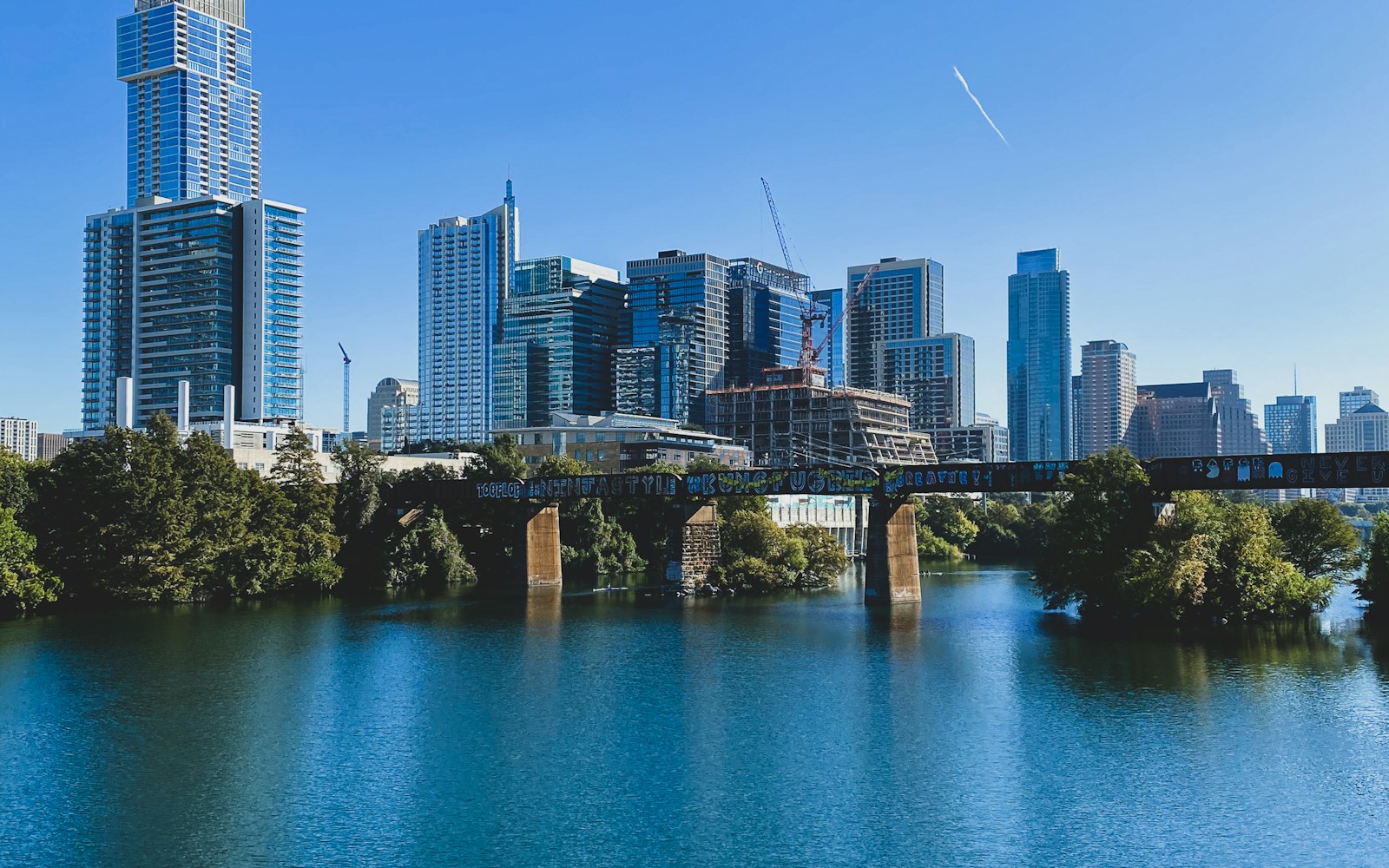
Photo: Max Miner via Unsplash, Unsplash License
Quick Answer: Austin closed and demolished its convention center in April 2025 and is building a replacement of about 620,000 rentable square feet, a project budgeted at roughly $1.6 billion and scheduled to open in early 2029. City figures show hotel occupancy tax revenue for fiscal year 2026 reached about $173.3 million, above the $167.3 million budget, although local reporting attributes the stability largely to a surge in short-term rental collections. Downtown hotels have reported sharp drops in group business during the closure.
As of November 16, 2026, Austin is roughly 19 months into a planned four-year stretch without its main convention venue. The old Austin Convention Center, a building more than 30 years old, has been taken down, the six-block site has been excavated, and steel has started to rise. The question for the hospitality industry in Central Texas is how much business is lost in the gap, and whether the tax stream that pays for the new building holds up while the building that generated much of it is gone.
What is Austin building, and what will it cost?
The project, branded UnconventionalATX by the Austin Convention Center Department, replaces the former center with a larger facility on the same downtown site. The department’s April 2025 announcement put the price at $1.6 billion and said rentable space would grow from 365,000 square feet to 620,000 square feet. The design team is a joint venture of LMN and Page; the builder is a joint venture of JE Dunn and Turner.
Later figures run slightly higher. Community Impact reported in October 2025 that the redevelopment was a $1.65 billion effort, and The Bond Buyer, describing the city’s bond offering in August 2026, cited a total project cost of $1.66 billion.
Northstar Meetings Group, a trade publication, reported the following breakdown of the new building: a 336,000-square-foot exhibit hall, a 92,000-square-foot flexible hall, a 47,000-square-foot ballroom and 70,000 square feet of outdoor space within the 620,000-square-foot total. The Bond Buyer reported that the expansion moves Austin from the 61st largest convention center in the United States to the 35th.
What are the key facts at a glance?
| Item | Detail | Source |
|---|---|---|
| Project cost | $1.6 billion (2025 announcement); $1.66 billion (2026 bond coverage) | Convention Center Department; The Bond Buyer |
| Rentable space | 620,000 sq ft, up from 365,000 | Convention Center Department |
| Closure | April 2025 | Convention Center Department |
| Target opening | Early 2029, before the spring festival season | UnconventionalATX progress report |
| Funding | Hotel occupancy tax and convention center revenue | Convention Center Department |
| Public art budget | $17.7 million | Convention Center Department |
| Projected annual economic impact | About $753.8 million, versus an estimated $468.8 million for the old center | City projection, reported by Community Impact |
Where does construction stand in late 2026?
The project’s public progress page, updated as of August 2026, lists structural demolition and the diaphragm wall as complete. The wall is the first permanent structural element of the enlarged six-block footprint. Excavation was 93% complete at that point, with about 940,000 cubic yards of soil to be removed in total and completion expected in fall 2026. Community Impact reported in September 2025 that crews would dig about 55 feet down.
Three construction cranes are installed, foundation pours are continuing through 2026, and vertical steel installation began in September 2026, according to the same progress report. On the design side, schematic design wrapped in October 2025, design development finished in spring 2026 and construction documents were described as nearly complete.
What sustainability targets has the city set?
The Convention Center Department has said the building is intended to be the world’s first zero-carbon-certified convention center. The progress report says 85% of materials from the original facility have been diverted from landfill, above a 75% goal.
How is the rebuild being paid for?
The city has said the project is funded by the hotel occupancy tax and convention center revenue, not by property taxes. Hotel guests in Austin pay a combined 17% occupancy tax, of which 11 percentage points go to the city, according to KUT.
The financing took shape in two steps. On October 23, 2025, the Austin City Council approved $650 million in hotel occupancy tax bonds, described by Community Impact as the first round of $1.2 billion in planned debt, along with $46.18 million in bonds to refund 2008 and 2012 debt tied to the original center. At the same meeting the council added $450 million to the original $1.2 billion construction contract with JE Dunn and Turner. Of that addition, $241.5 million covers excavation, civic infrastructure and mobility work, and $207 million, funded through Austin Energy, pays for a new standalone district cooling plant to replace one that sat on the old center’s roof.
In August 2026 the city brought the first bonds to market. The Bond Buyer reported a $663 million offering made up of $540.55 million of senior lien and $122.45 million of junior lien special tax revenue bonds, with about $600 million more expected by June 2027 and roughly $410 million of the project to be paid in cash.
What revenue backs the bonds?
According to The Bond Buyer, the bonds are secured by 6.5 percentage points of the city’s 11% hotel tax: a 4.5% portion and a 2% expansion portion. Pledged hotel tax revenue was $50.2 million in 2020 and was projected to reach $101 million in 2026. The pledge also includes certain state sales, hotel and mixed beverage taxes generated inside a project finance zone established in 2024; base-year 2024 collections of those state taxes were nearly $89.7 million.
The senior lien bonds carried ratings of AA-minus from S&P Global Ratings and KBRA and Aa2 from Moody’s. The junior lien bonds were rated Aa3 by Moody’s, A-plus by KBRA and BBB-plus by S&P, which capped its junior rating because of thin expected debt service coverage. Projected maximum annual coverage was under 1.25 times.
What do hotel occupancy tax collections show during the closure?
The clearest city data comes from monthly hotel occupancy tax updates prepared by the Austin Arts, Culture, Music and Entertainment office. The city’s fiscal year runs from October through September, so fiscal year 2026 was the first full fiscal year without the convention center.
| Point in fiscal year 2026 | Total hotel tax revenue, year to date | Cultural Arts Fund transfer, year to date |
|---|---|---|
| Through October 2025 | $27,955,560 | $2,669,756 |
| Through November 2025 | $34,515,375 | $3,297,566 |
| Through March 2026 | $81,243,917 | $7,758,794 |
| Through April 2026 | $118,916,133 | $11,357,339 |
| Through September 2026 (full year) | $173,324,810 | $16,592,241 |
| Approved budget, fiscal year 2026 | $167,288,265 | $15,968,425 |
Source: City of Austin hotel occupancy tax updates dated November 2025 through October 2026. Figures include encumbrances and are as reported in the city’s slides; monthly amounts vary widely because most payments post quarterly.
The full-year total came in about $6 million, or roughly 3.6%, above the approved budget. The Cultural Arts Fund share rose to $16.59 million from $15.34 million in fiscal year 2025, $15.57 million in fiscal year 2024 and $15.65 million in fiscal year 2023, according to the city’s October 2026 update. That is an increase of about 8% in a year when the city’s largest meeting venue was a construction site.
Why did collections hold up?
Short-term rentals account for much of it. Since April 2025, the same month the center closed, booking platforms such as Airbnb and VRBO have been required to collect and remit Austin’s hotel tax directly. KUT reported on October 29, 2026, that hotel tax collections from short-term rentals more than tripled over two years to $23.7 million, an increase of $16.8 million, and now make up nearly 14% of the total, up from about 4%. KUT also reported that without that growth, overall collections would have declined.
Large events filled part of the gap as well. The city’s spring 2026 update credited South by Southwest, Rodeo Austin, the MotoGP Grand Prix and a food festival for April collections of about $37.7 million.
How have hotels performed without the convention center?
Hotel-level performance data in Austin is mostly proprietary, but the published indicators point the same way: weaker group demand downtown, partly offset by leisure travel and special events.
- Group demand: CoStar reported in June 2025 that upper-tier downtown hotels saw a 13% decline in group demand in April 2025, the first month of the closure. In May 2026 it reported that the closure had pulled down regional hotel performance over the 12 months through March.
- Citywide occupancy, summer 2025: Figures from Visit Austin’s marketing team, published by Informa Connect, show occupancy from May through September 2025 down 5.3% year over year while hotel supply grew 2.3%. The gap narrowed from 8.7% in May to 5.1% in August, and September occupancy was up 0.8%.
- Hotel operators: Community Impact reported in October 2025 that the general manager of the JW Marriott Austin described double-digit decreases in monthly room occupancy and that the Hilton Austin’s general manager reported job cuts.
- South by Southwest 2026: Northstar Meetings Group reported that citywide demand rose 12% over the prior year during the front half of the shortened March 11-18 event, with occupancy reaching 95% on Friday, March 13, before tapering in the back half.
- World Cup spillover: Axios reported, citing Visit Austin, that citywide hotel occupancy rose 11% and hotel revenue rose 20% year over year from June 11 to June 30, 2026, even though Austin hosted no matches.
What is being done to fill rooms until 2029?
Austin hotels now fund a Tourism Public Improvement District through a 2% nightly fee on most rooms. The Real Deal, citing the Austin Business Journal, reported in December 2025 that the fee was expected to raise almost $30 million in 2026, with 30% directed to advertising, 30% to sales and 20% to convention-related incentives, and that Visit Austin had secured 37 smaller multi-hotel events for 2026 through 2028.
Hotels have also grouped themselves into packages that can host meetings without a convention hall. Northstar described three: a university-area collection of five hotels with about 850 rooms, a Red River collection built around the 1,048-room Fairmont Austin, the 801-room Hilton Austin and the 319-room Hotel Van Zandt, and an 11-hotel Marriott-branded collection with 3,629 rooms and 225,000 square feet of event space. During construction, city events have shifted to the Palmer Events Center and smaller venues.
How large is Austin’s visitor economy?
Visit Austin’s tourism impact page currently cites 30.2 million domestic visitors a year, $11.4 billion in annual economic impact from visitor spending and 151,700 jobs supported across the region. The page credits Travel Texas 2025 data, the Texas Workforce Commission, the U.S. Bureau of Labor Statistics, the City of Austin and the analytics firm Zartico, and does not tie each figure to a specific year.
For statewide context, the Texas Governor’s Travel Texas office reports that travel spending in Texas totaled $98.7 billion in 2025, supporting 1.3 million jobs and $80.8 billion in earnings, with total economic impact of $201.8 billion, based on research by Dean Runyan Associates.
What does the future booking pipeline look like?
Northstar reported that the new center had 27 confirmed events representing 238,117 room nights and more than $205 million in economic impact, plus verbal commitments for 22 more events worth 182,239 room nights and about $155 million.
The project has also faced organized opposition. A political action committee, Austin United, submitted a petition in October 2025 seeking to pause construction and redirect hotel tax revenue. The Bond Buyer reported that the city clerk found the petition 494 signatures short of the 20,000 required, that the Texas Supreme Court dismissed a related mandamus petition and that an appeal was pending in a state appellate court as of August 2026.
Frequently Asked Questions
When will the new Austin Convention Center open?
The city’s target is early 2029, in time for that year’s spring festival season. The project’s progress report maintained that date as of August 2026.
How much does the Austin Convention Center redevelopment cost?
The city announced a $1.6 billion project in April 2025. Coverage of the August 2026 bond sale put total project cost at $1.66 billion.
Do Austin property taxpayers fund the project?
The city says the project is paid for with hotel occupancy tax and convention center revenue. The district cooling plant portion is funded through Austin Energy’s cooling network customers.
How big will the new convention center be?
About 620,000 rentable square feet, compared with 365,000 in the old building, roughly 70% more.
Did Austin’s hotel tax revenue fall after the center closed?
Not in total. Fiscal year 2026 revenue was about $173.3 million against a $167.3 million budget, but KUT reported that collections would have declined without growth in short-term rental payments.
How much hotel tax does a guest pay in Austin?
The combined rate is 17%, with 11 percentage points going to the City of Austin, plus a separate 2% tourism district fee at most hotels.
Sources and Further Reading
- Austin Convention Center Launches UnconventionalATX, Austin Convention Center Department
- Site Progress, UnconventionalATX (City of Austin)
- Hotel Occupancy Tax Updates, November 2025 through October 2026, City of Austin Arts, Culture, Music and Entertainment
- Tourism Impact, Visit Austin
- 2025 Economic Impact of Travel, Office of the Texas Governor, Travel Texas
- Austin to Sell $663 Million of Bonds to Replace Convention Center, The Bond Buyer
- Short-term rental tax collections and arts funding report, KUT News
- Demolition of Austin Convention Center Nearly Complete, Community Impact
- Hundreds of Millions OK’d for Austin Convention Center Redevelopment, Community Impact
- Austin, Texas: A Year Without a Convention Center, Northstar Meetings Group
- How Visit Austin Turned a Convention Center Closure Into a Marketing Win, Informa Connect
- Austin hotel performance reports, June 2025 and May 2026, CoStar News
- Austin Scores World Cup Bump, Axios Austin
- Austin Bets on Travel Push as Convention Center Gap Drags, The Real Deal