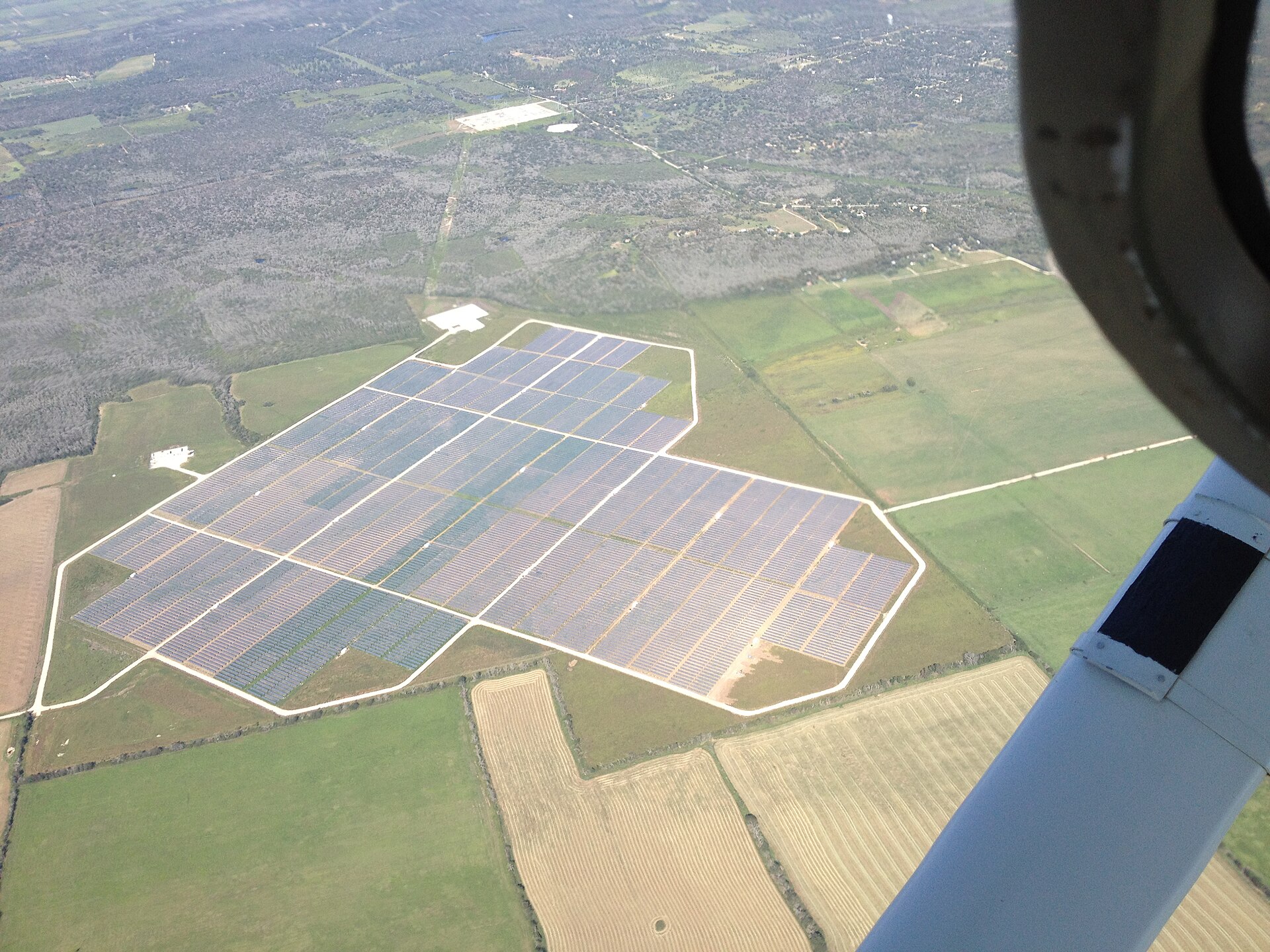
Webberville solar farm near Austin from the air. Source: Wikimedia Commons, CC0 public domain dedication.
Quick Answer: Austin Energy, the city-owned electric utility, serves roughly 582,000 customer accounts across 437 square miles and is operating under a fiscal 2027 budget proposed at about $2.06 billion. Base rates rose 5% on Oct. 1, 2026, adding about $3.66 a month to the average bill, and the utility’s five-year capital plan totals $3.26 billion, nearly half of it for new power production.
Austin Energy is one of the largest businesses in Central Texas that most residents never think of as a business. It has been community-owned since 1895, it sends well over $100 million a year to the City of Austin’s General Fund, and its decisions on power plants, batteries and rates shape costs for every employer in the city. The fiscal year that began Oct. 1, 2026 brings the largest capital program in the utility’s recent history. Here is what the utility’s own reports, city budget documents and council records show.
How big is Austin Energy?
In the fiscal year that ended Sept. 30, 2025, Austin Energy had 575,087 customers: 519,798 residential, 55,154 commercial and 135 industrial. Its quarterly financial report shows average customers of 582,179 for the nine months ended June 2026, up 1.7% from a year earlier. The service area covers Austin and parts of Travis and Williamson counties, and the utility says it serves more than one million residents.
Those 135 industrial accounts matter more than their number suggests. Of 14.5 million megawatt-hours sold in fiscal 2025, industrial customers bought 3.3 million, commercial customers 6.0 million and residential customers 5.2 million. Revenue by class was $671.6 million residential, $642.0 million commercial and $230.6 million industrial, for a total of $1,544.2 million.
The physical system includes 633.5 miles of transmission lines, 12,337 miles of distribution lines, 81 substations and 164,229 distribution poles. The utility reported 1,934 employees in fiscal 2025. According to Austin Energy, five of the 20 largest U.S. cities own their electric utility, and among those only San Antonio and Los Angeles are larger than Austin. Stuart Reilly is general manager.
| Item | Figure |
|---|---|
| Founded as a community-owned utility | 1895 |
| Service area | 437 square miles |
| Customers, fiscal 2025 | 575,087 |
| Electricity sold, fiscal 2025 | 14.5 million MWh |
| Employees, fiscal 2025 | 1,934 |
| Transmission lines | 633.5 miles |
| Distribution lines | 12,337 miles |
| Substations | 81 |
| Generation capacity | More than 4,600 MW |
| S&P credit rating, Sept. 2026 | AA- |
Sources: Austin Energy By the Numbers, Power Plants page and quarterly financial report.
What is in Austin Energy’s fiscal 2027 budget?
The Austin City Council adopted a $6.6 billion citywide budget in August 2026. Austin Energy’s proposed portion, presented to the Electric Utility Commission on July 20, 2026, showed revenues and transfers in of $2,059.7 million against total requirements of $2,057.5 million. The line items below come from that proposed budget; the rate changes it contained match the rates the utility lists as approved.
Base revenue is projected at $810.8 million, up $61.6 million from fiscal 2026. The utility attributed about $40 million of that to the 5% base rate increase and $21 million to customer and load growth. Power supply revenue is budgeted at $601.3 million, regulatory charges at $266.8 million, community benefit charges at $126.4 million and transmission revenue at $117.7 million.
On the spending side, operations and maintenance is $619.3 million, including $359.2 million for personnel. Power supply costs are $531.0 million, transmission and ERCOT costs $234.8 million, and debt service $237.3 million, up $42.3 million in a single year.
How much does Austin Energy send to the city?
The General Fund transfer, the utility’s annual payment to the city that owns it, rises to $147.0 million from $139.0 million. The utility’s forecast shows it reaching $151 million in fiscal 2028 and $174 million by fiscal 2031. The transfer was $125 million in fiscal 2025 and $115 million in fiscal 2024.
How did fiscal 2026 turn out?
Unaudited results for the 12 months ended September 2026 show operating revenues of $1,882 million against a budget of $1,902 million and operating expenses of $1,400 million against a budget of $1,464 million. After debt service of $195 million and transfers, costs exceeded revenues by $8 million, a smaller gap than the $43 million shortfall that had been budgeted. Days of cash on hand ended at 187, debt service coverage was 2.3 times against a target above 2.5, and debt to capitalization was 58% against a target below 50%.
How much are Austin Energy bills going up?
For Oct. 1, 2026 through Sept. 30, 2027, base rates rose 5%, the Power Supply Adjustment fell 5% and the Community Benefit Charge fell 13.9% overall. Austin Energy puts the net effect at about $3.66 a month on the average bill.
The utility’s typical residential bill, based on 860 kilowatt-hours a month, moves to $120.73 from $117.07. That is still below the $121.96 of fiscal 2025. The base portion rises $2.99 to $62.18 and the regulatory charge rises $3.96 to $15.47, while the Power Supply Adjustment falls $1.77 to $33.64 and the Customer Assistance Program charge falls $1.28 to $3.57. Customers on the assistance program see a discounted bill of $89.83.
In a comparison the utility prepared using July 2026 rates at the same usage, Austin Energy’s bill was $121, compared with $127 in Georgetown, $137 for Bluebonnet Electric Cooperative, $142 in San Antonio and $152 for Pedernales Electric Cooperative. For the city as a whole, combined rates and fees rose $172.08 a year, or $14.34 a month, for a typical ratepayer.
| Component | Fiscal 2027 | Change |
|---|---|---|
| Base charges | $62.18 | +$2.99 |
| Power Supply Adjustment | $33.64 | -$1.77 |
| Regulatory charge | $15.47 | +$3.96 |
| Customer Assistance Program | $3.57 | -$1.28 |
| Energy efficiency services | $3.53 | -$0.40 |
| Service area lighting | $2.34 | +$0.16 |
| Total | $120.73 | +$3.66 |
Source: Austin Energy fiscal 2027 proposed budget presentation.
Where does Austin’s electricity come from?
Austin Energy lists more than 4,600 megawatts of generating capacity. Its owned plants include the 595-megawatt Sand Hill Energy Center in Del Valle and 200 megawatts of gas turbines at Decker Creek, both fueled by natural gas. It owns a 600-megawatt share of the coal-fired Fayette Power Project near La Grange, which the Lower Colorado River Authority co-owns and manages, a 430-megawatt share of the South Texas Project nuclear plant and the 105-megawatt Nacogdoches biomass plant.
Contracts supply the renewable portion: 1,795.64 megawatts of wind across 10 projects and 966 megawatts of utility-scale solar across seven, for 2,866.64 megawatts in all. The Webberville solar project east of Austin accounts for 30 megawatts of that.
Carbon-free sources covered 77% of customer load in fiscal 2022, 70% in 2023 and 65% in both 2024 and 2025, according to the utility’s plan update. In the July through September 2026 quarter the figure was 56%, with renewables supplying 37% of consumption and nuclear 19%. The system peak that quarter was 3,097 megawatts, compared with 2,928 in the same quarter of 2025 and 3,110 in 2024.
What does the 2035 plan call for?
The council adopted the Resource, Generation and Climate Protection Plan to 2035 in 2024. Its central goal is carbon-free generation equal to 100% of load by 2035. The January 2026 update says efforts to exit the Fayette coal plant continue, without an exit date. Local targets include 205 megawatts of local solar by 2027 and 405 by 2035, against 189 installed in fiscal 2025, when a record 18.8 megawatts was added. Demand response reached a record 57 megawatts in 2025, with goals of 78 by 2027 and 270 by 2035.
What new power and storage is Austin Energy adding?
Batteries are the fastest-moving piece. In October 2025 the utility signed an agreement with Jupiter Power for up to 100 megawatts at about $14.4 million a year for up to 20 years. On April 23, 2026 the council approved an agreement with Base Power for up to 40 megawatts of customer-sited batteries over 10 years at about $4 million a year; about 185 installations totaling 3.7 megawatts were in place as of October 2026.
A 100-megawatt deal with OCI Energy approved in May fell through when the parties could not agree on terms. Its replacement, announced Oct. 28, 2026, is a Jupiter Power subsidiary project called Balcones Ridge Resiliency II: up to 200 megawatts of two-hour storage, at no more than $16 million a year for up to 20 years, or $320 million in total, with commercial operation in 2030. That brings the contracted battery portfolio to 340 megawatts.
On wind, the council on May 21, 2026 authorized up to two agreements with Invenergy Renewables for about 299 megawatts in Mills and Dickens counties, at about $34 million a year for 10 years.
The most contested item is natural gas. Austin Energy’s May 21 news release and Community Impact reported that the council approved 400 megawatts of new gas peaker units that day; the city’s official action notes for that meeting list the peaker item as withdrawn. The Electric Utility Commission had recommended the peakers 8 to 3 on May 11, and on May 28 the council approved resolutions setting emissions caps and siting conditions. Cost and vendor have not been disclosed.
What is in the $3.26 billion capital plan?
Capital spending is where the fiscal 2027 budget departs most from the past. The plan calls for $1,006.6 million in fiscal 2027, compared with $422.4 million approved for fiscal 2026. The five-year program for fiscal 2027 through 2031 totals $3,258.3 million.
Power production accounts for $1,560.4 million of that, including $636.6 million in fiscal 2027 alone, up from $55.6 million the prior year. Distribution is $751.1 million, transmission $646.3 million and distribution substations $120.1 million. Named fiscal 2027 projects include $16.5 million for the Bolm Substation and $10.9 million for the Brackenridge Substation.
The borrowing shows up in the utility’s own forecasts. Debt service is projected to climb from $237.4 million in fiscal 2027 to $347.4 million in fiscal 2031. Debt to capital is forecast at 63% in fiscal 2027 and 67% by fiscal 2029, and days of cash at 161. S&P rated the utility AA- as of September 2026, below Austin Energy’s AA target.
| Category | Five-year total | Fiscal 2027 |
|---|---|---|
| Power production | $1,560.4 million | $636.6 million |
| Distribution | $751.1 million | $147.7 million |
| Transmission | $646.3 million | $110.6 million |
| Distribution substations | $120.1 million | n/a |
| General | $123.2 million | n/a |
| District cooling | $57.2 million | n/a |
| Total | $3,258.3 million | $1,006.6 million |
Source: Austin Energy fiscal 2027 proposed budget presentation.
How is the utility preparing for data centers and storms?
A city memo reported by Community Impact in December 2025 said data center requests that once topped out near 30 megawatts now routinely run 10 times that or more, with some inquiries of 5,000 to 11,000 megawatts, against a system peak of just over 3,000. Statewide, ERCOT set a demand record of 91,308 megawatts on July 22, 2026.
On reliability, Austin Energy announced an Electric System Resiliency Plan in December 2025 worth $735 million over 10 years: $340 million for vegetation management and wildfire mitigation, $280 million for circuit hardening, poles and automation, and $115 million for intelligent systems and analytics. A 2025 study found that burying all overhead lines would cost about $50 billion and take decades.
Frequently Asked Questions
How many customers does Austin Energy have?
It had 575,087 customers in fiscal 2025 and averaged 582,179 in the nine months ended June 2026.
How much did Austin Energy rates go up in October 2026?
Base rates rose 5%. After decreases in other charges, the average bill rose about $3.66 a month, and the typical 860 kilowatt-hour residential bill is $120.73.
Who owns Austin Energy?
The City of Austin. The utility has been community-owned since 1895 and transfers money to the city’s General Fund each year, budgeted at $147.0 million for fiscal 2027.
Does Austin Energy still use coal?
Yes. It owns a 600-megawatt share of the Fayette Power Project. The utility says efforts to exit continue but has not set a date.
How much battery storage has Austin Energy contracted?
About 340 megawatts, including a 200-megawatt Jupiter Power project announced Oct. 28, 2026 and due online in 2030.
How much will Austin Energy spend on capital projects?
The plan calls for $1,006.6 million in fiscal 2027 and $3,258.3 million over five years.
Sources and Further Reading
- Austin Energy By the Numbers – Austin Energy
- FY 2027 Proposed Budget presentation to the Electric Utility Commission – Austin Energy, City of Austin
- Approved Electric Rates – Austin Energy
- Quarterly Financial Report, 4th Quarter FY 2026 – Austin Energy
- Operations Update, FY 2026 Q4 – Austin Energy
- Power Plants and Renewable Power Generation pages – Austin Energy
- Resource, Generation and Climate Protection Plan to 2035: Semi-Annual Update – Austin Energy
- Austin Energy inks deal with Jupiter Power for 200 MW battery storage – City of Austin
- Council action notes, May 21, 2026 – City of Austin
- Austin officials greenlight new natural gas units in major power generation, storage expansion – Community Impact
- Austin Energy announces Electric System Resiliency Plan – City of Austin
- Austin City Council approves $6.6 billion budget for FY 2026-2027 – City of Austin