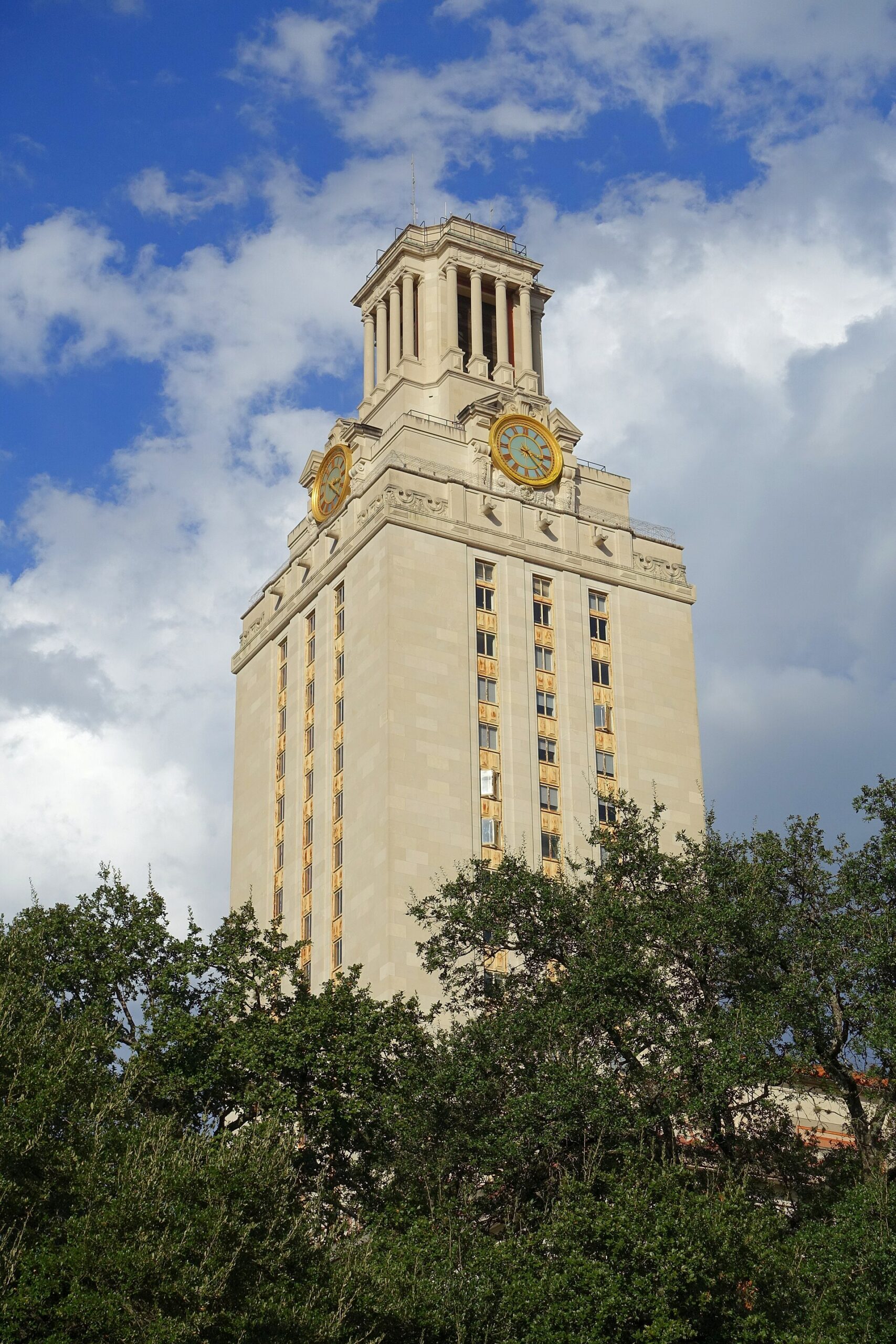
The Main Building at the University of Texas at Austin. Photo: Daderot, via Wikimedia Commons, CC0 public domain dedication.
Quick Answer: The University of Texas at Austin enrolled a record 55,172 students in fall 2026 and is operating on a fiscal 2027 budget of about $5.1 billion in revenue and $4.9 billion in expenses. It reported $1.37 billion in research spending for fiscal 2025, and its capital program reached $3.44 billion in August 2026 after regents added a $1 billion first phase of the UT Dell Medical Center.
The University of Texas at Austin is usually discussed as a school. Its financial documents describe something closer to a large diversified enterprise: a payroll of about $2.8 billion, a research operation above $1 billion a year, a construction pipeline measured in billions and a claim on one of the largest public endowments in the country. The figures below are the most recent official ones available as of November 18, 2026.
| Measure | Latest figure | Period |
|---|---|---|
| Total enrollment | 55,172 | Fall 2026 |
| Budgeted revenue | $5.11 billion | Fiscal 2027 |
| Research expenditures (university figure) | $1.37 billion | Fiscal 2025 |
| Capital Improvement Program | $3.44 billion, 15 projects | August 13, 2026 |
| Endowment market value | $22.8 billion | Fiscal 2025 |
| Non-faculty, non-student employees | 15,540 | Fall 2025 |
How many students are enrolled at UT Austin in fall 2026?
UT Austin reported official fall 2026 enrollment of 55,172 on September 22, 2026, the largest student body in its history. Of that total, 44,556 are undergraduates. The university’s facts page lists the remaining 10,616 as graduate and professional students.
The gain over fall 2025 is small. The university reported 55,000 students that fall, including 44,314 undergraduates, so total enrollment rose by 172 students, or about 0.3%, and undergraduate enrollment rose by 242. The prior year’s increase was 2.1%.
Is the freshman class still growing?
No. The entering class of first-time freshmen was 9,487 in fall 2026, compared with 9,900 a year earlier, a decline of 413 students or about 4%. Demand went the other way: UT received 98,841 freshman applications for fall 2026, about 9% more than the 90,690 it reported for the prior cycle. Headcount is no longer the main source of the university’s financial growth.
Output measures improved. UT reported a four-year graduation rate of 77.7%, up from 75.7% the year before, and 16,797 degrees awarded in the 2025-26 academic year, which it described as an all-time high.
How big is UT Austin’s operating budget for fiscal 2027?
The fiscal 2027 budget for the year ending August 31, 2027, which regents took up in August 2026, projects total revenue of $5,108.7 million. That is $540.1 million, or 11.8%, more than the adjusted fiscal 2026 budget. Expenses and transfers are budgeted at $4,873.1 million, up $369.6 million or 8.2%. The difference is a budgeted margin of $235.6 million, compared with $65.1 million in the fiscal 2026 adjusted budget.
Where does the money come from?
| Revenue source | FY 2026 adjusted | FY 2027 budget | Change |
|---|---|---|---|
| Federal sponsored programs | $844.5M | $1,274.4M | +50.9% |
| Tuition and fees (gross) | $791.1M | $825.7M | +4.4% |
| Available University Fund transfers | $536.0M | $640.7M | +19.5% |
| Net auxiliary enterprises | $453.8M | $518.1M | +14.2% |
| State appropriations | $516.1M | $480.3M | -6.9% |
| Local and private sponsored programs | $287.6M | $341.2M | +18.6% |
Three points stand out. First, federal sponsored programs are the largest single line at $1.27 billion, roughly a quarter of all revenue, and the budget assumes they grow by $429.9 million in one year. That makes the plan unusually dependent on research awards arriving as projected.
Second, state appropriations are budgeted at $480.3 million, about 9% of revenue, and are falling. The budget narrative attributes the decline to the front-loading of certain non-formula support items in the prior year.
Third, gross tuition and fees of $825.7 million are offset by $427.3 million in discounts and allowances, up from $217.2 million. The budget narrative attributes the jump to a revised discounting methodology, so that line is not comparable year over year.
How much of the budget is payroll?
Personnel costs are budgeted at $2,775.7 million for fiscal 2027, up $260.1 million or 10.3%, and equal to about 57% of budgeted expenses and transfers. That total breaks down into $653.5 million in faculty compensation, $1,454.7 million in non-faculty compensation, $48.6 million in wages and $618.8 million in benefits. The budget includes a 2.0% merit pool.
How many people does UT Austin employ?
The answer depends on who is counted. The UT System’s 2026 SmartBook reports 28,714 non-faculty employees at UT Austin in fall 2025. That includes 13,174 student employees; excluding them leaves 15,540 administrative and other staff. Faculty are counted separately, and the university’s facts page lists 4,760 faculty for fall 2026. Together those figures point to roughly 20,000 non-student employees, though they come from different dates and sources.
On a full-time-equivalent basis, the Texas State Auditor’s Office workforce summary for fiscal 2024 counted 18,612.9 FTEs, of which 13,233.3 were paid from non-appropriated funds. About seven in ten positions were supported by something other than state appropriations.
How much research does UT Austin conduct?
UT reports $1.37 billion in total research expenditures for fiscal 2025, up about 20% from $1.14 billion in fiscal 2024. The university says more than 75% of its externally funded research is financed by federal agencies.
The UT System SmartBook, which uses Texas Higher Education Coordinating Board data, reports a lower fiscal 2025 figure of $1,285.1 million. The two totals rest on different reporting definitions. In the coordinating board data, $875.9 million, or 68%, came from federal sources.
Where does UT rank nationally?
The latest national comparison is the National Science Foundation’s Higher Education Research and Development Survey for fiscal 2024, released in December 2025. According to UT’s summary of that survey, the university ranked first among U.S. universities in research funded by the National Science Foundation, at $176.4 million, fifth in Department of Defense funding and sixth in Department of Energy funding. Its federal research spending of nearly $700 million was the highest of any Texas institution.
The National Center for Science and Engineering Statistics schedules the fiscal 2025 survey release for November 24, 2026.
What is UT building, and what does the medical center cost?
The UT System’s Capital Improvement Program report dated August 13, 2026 lists 15 UT Austin projects with a combined cost of $3,441.4 million. That is about 22% of the system’s $15.8 billion program across 82 projects. The May 2026 report showed 14 projects totaling $2,441.4 million; the $1 billion difference is the first phase of the UT Dell Medical Center.
| Project | Total project cost |
|---|---|
| UT Dell Medical Center, Phase 1 | $1,000.0M |
| Medical complex enabling: central utility plant and infrastructure | $515.0M |
| McCombs School of Business new building | $425.0M |
| Microelectronic and Engineering Research Center cleanroom expansion | $394.1M |
| Engineering Discovery Building | $324.0M |
What has been approved for the UT Dell Medical Center?
On August 12, 2026, regents added Phase 1 of the UT Dell Medical Center to the capital program at a total project cost of $1 billion. The agenda item describes the facility as a tertiary care medical center of approximately 2.5 million gross square feet on about 27 acres, built in partnership with MD Anderson Cancer Center. Phase 1 is early work rather than a finished hospital: site clearing, excavation, below-grade structures and orders for long-lead building and utility components.
Phase 1 is funded entirely with $1 billion in Revenue Financing System bond proceeds, with annual debt service of about $56 million expected to be repaid from clinical revenues. The schedule called for a construction notice to proceed in September 2026 and final completion in December 2030. Community Impact has reported the full project cost at $5 billion, the same figure regents approved in June 2025 for the earlier downtown version of the plan.
The project moved during the past year. It was first planned for a downtown site. On April 21, 2026 UT announced the medical center would anchor a new UT Dell Campus for Advanced Research of more than 300 acres off MoPac, backed by a $750 million gift from Michael and Susan Dell. The Texas Tribune reported the hospital is expected to have about 300 to 500 beds, with size and scope not final, and that the downtown Dell Seton Medical Center will not be replaced.
Add the $515 million enabling project and the medical campus already represents about $1.5 billion, or 44% of UT Austin’s approved capital program, before the main hospital construction phases are brought to the board.
How large are UT Austin’s endowment and the Permanent University Fund?
The SmartBook, citing CASE Insights, puts the market value of UT Austin’s endowment at $22.8 billion for fiscal 2025, up 56% over five years. Annual giving was $623.0 million in fiscal 2025.
Behind that sits the Permanent University Fund, the state endowment built on about 2.1 million acres in 24 West Texas counties. The UT System’s October 2026 legislative appropriations request reports the fund’s net asset value at $45.0 billion as of August 31, 2026. Distributions from the fund to the Available University Fund were $1.52 billion in fiscal 2025 and $2.23 billion in fiscal 2026, and are budgeted at $2.45 billion in fiscal 2027. One third goes to the Texas A&M University System. The UT System’s share is the source of the $640.7 million UT Austin has budgeted this year, an amount larger than its state appropriations.
How many startups and patents come out of UT Austin?
For fiscal 2025, UT’s commercialization office, Discovery to Impact, reported 300 invention disclosures, a 15% increase from fiscal 2024, along with 154 new patent applications, 112 new license agreements and 12 startups formed. It maintains more than 850 active license agreements and a $10 million UT Seed Fund that has backed nine startups since 2022.
Revenue is where sources diverge. The university reports $182 million in licensing revenue generated in fiscal 2025. The UT System SmartBook lists fiscal 2025 technology transfer revenue for UT Austin at $25.2 million. The documents reviewed do not reconcile the two figures, so the larger number should be read with that caveat.
What should Central Texas businesses watch next?
- Federal research funding. The fiscal 2027 budget assumes federal sponsored program revenue of $1.27 billion. Any shortfall would show up first in research staffing and lab purchasing.
- The November 24 survey release. Fiscal 2025 federal data will update UT’s national research rankings.
- Medical center phases. Phase 1 covers only early work, so further approvals are needed for a building program that runs through 2030.
- Arena and housing. The posted agenda for the regents’ November 18-19, 2026 meeting lists executive session items on ground leases of about 5.2 acres along East Martin Luther King Jr. Boulevard for a multipurpose arena and about 1.1 acres for student housing. No costs are stated.
Frequently Asked Questions
What is UT Austin’s enrollment in fall 2026?
UT Austin reported 55,172 students for fall 2026, including 44,556 undergraduates and 10,616 graduate and professional students.
What is UT Austin’s annual budget?
The fiscal 2027 budget projects $5.11 billion in revenue and $4.87 billion in expenses and transfers for the year ending August 31, 2027. Personnel costs account for $2.78 billion.
How much of UT Austin’s budget comes from the state?
State appropriations are budgeted at $480.3 million in fiscal 2027, about 9% of total revenue. Transfers from the Available University Fund, at $640.7 million, are larger.
How much will the UT Dell Medical Center cost?
Regents approved a $1 billion first phase in August 2026, financed with bonds to be repaid from clinical revenues. The full project has been reported at $5 billion, with completion targeted for 2030.
How much research does UT Austin do each year?
The university reports $1.37 billion in research expenditures for fiscal 2025. UT System data based on state definitions show $1.29 billion.
What economic impact does UT Austin claim?
The university states that it adds $18 billion a year to the Texas economy and that its 404,843 alumni in Texas generate $11.7 billion in added income annually. The page presenting those figures does not identify the underlying study or its date.
Sources and Further Reading
- UT Sets Academic Performance Records (September 22, 2026), UT News, The University of Texas at Austin
- UT Sets All-Time Highs for Enrollment and Student Performance (September 18, 2025), UT News, The University of Texas at Austin
- Facts and Figures, The University of Texas at Austin
- Impact on Texas, The University of Texas at Austin
- Fiscal Year 2027 Operating Budget, The University of Texas at Austin, The University of Texas System
- Fiscal Year 2027 Operating Budget Summaries, The University of Texas System
- UT System SmartBook 2026, The University of Texas System
- Capital Improvement Program quarterly reports, May 21, 2026 and August 13, 2026, The University of Texas System
- Facilities Planning and Construction Committee agenda book, August 2026, UT System Board of Regents
- Board of Regents meeting posting, November 18-19, 2026, The University of Texas System
- Available University Fund Legislative Appropriations Request, October 2026, The University of Texas System
- UT Ranks No. 1 in U.S. for Research Funded by National Science Foundation (January 8, 2026), UT News
- TEXAS Research by the Numbers, Office of the Vice President for Research, The University of Texas at Austin
- Schedule of Release Dates, National Center for Science and Engineering Statistics, National Science Foundation
- Discovery to Impact 2025 Annual Report and accompanying UT News release (January 15, 2026), The University of Texas at Austin
- Workforce Summary for The University of Texas at Austin, Fiscal Year 2024, Texas State Auditor’s Office
- Coverage of the UT Dell Medical Center, November 2025 through August 2026, Community Impact
- Coverage of the Dell gift and the UT Dell Campus for Advanced Research (April 21, 2026), The Texas Tribune