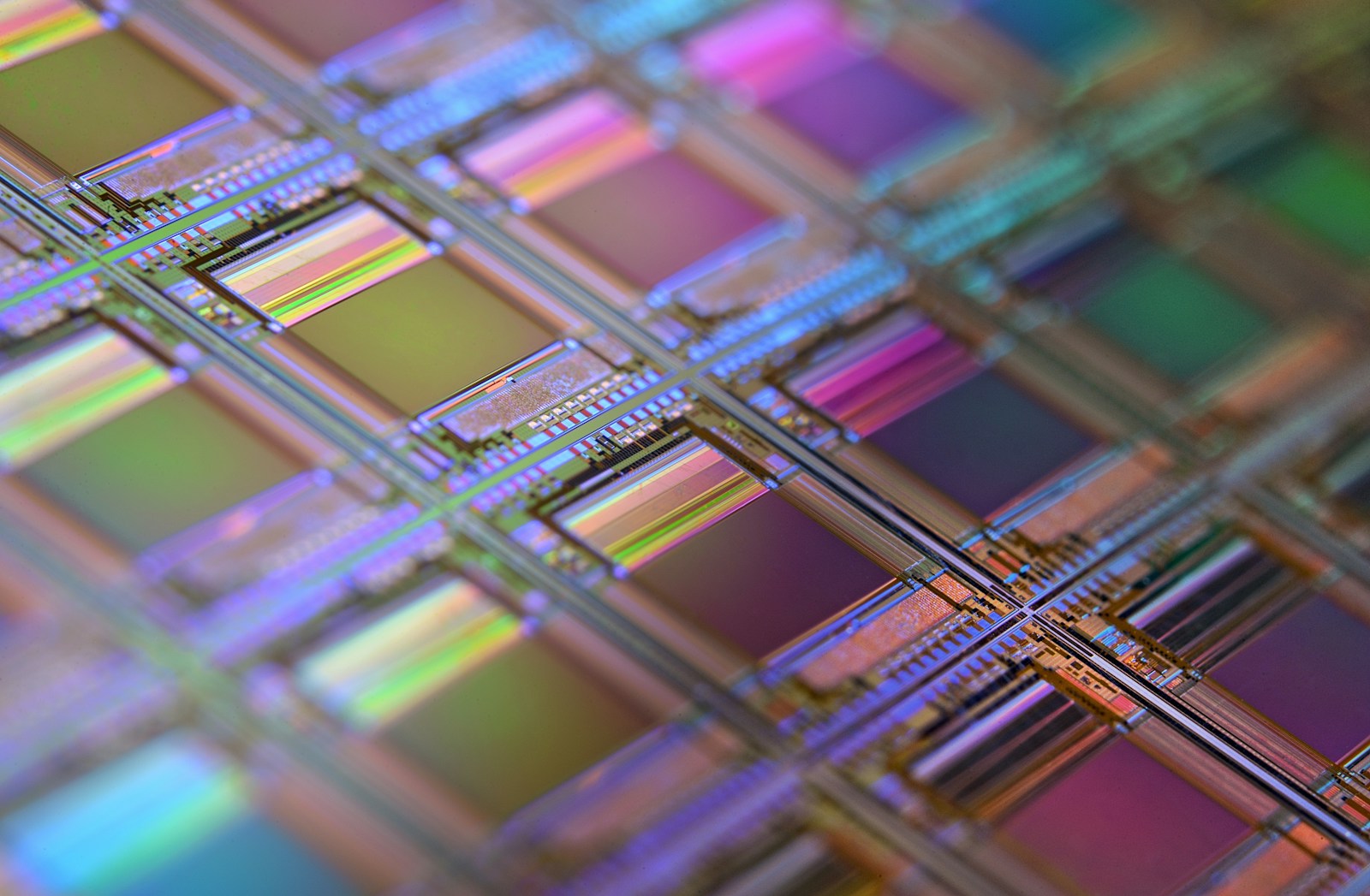
Photo: Laura Ockel / Unsplash (Unsplash License)
Quick Answer: As of November 16, 2026, Samsung’s first chip plant in Taylor has not started commercial production. Korean press reports citing industry sources say trial operations could begin as early as mid-to-late December 2026, with mass production planned for 2027 and Tesla’s AI6 chip targeted for the second half of 2027. The federal CHIPS award stands at up to $4.745 billion against more than $37 billion of planned Samsung spending in Central Texas, and a second Taylor fab is aimed at mass production in 2030.
Samsung picked its Williamson County site in November 2021. Five years on, equipment is being installed, a second plant has been announced and suppliers have moved in around it with state grant money.
Where does Samsung’s Taylor fab stand in November 2026?
The Korea Herald reported on November 8, 2026, citing unnamed industry sources, that trial operations at the Taylor foundry could begin as early as December. Samsung has not confirmed a date. The company has been installing equipment, setting up production lines and running performance checks, the report said.
Samsung’s public position has been consistent. Spokeswoman Michele Glaze told the Taylor Press earlier in 2026 that the project plans to be operational by the end of the year, and the Korea Herald said she confirmed that timeline in late October. Mass production is planned for 2027.
How late is the project?
About two years. Construction began in 2022, operations were first targeted for the second half of 2024, and Samsung moved the target to the end of 2026 in April 2025, the Taylor Press reported. TrendForce, summarizing Korean reports in April 2026, said mass production readiness had passed 90 percent, with core equipment beginning to arrive that month.
What will the fab make?
Leading-edge logic chips on Samsung’s 2-nanometer process. The federal CHIPS program office describes the Taylor plan as two leading-edge logic fabs for 2-nanometer mass production plus a research and development fab for future process nodes. Yield, the share of usable chips per wafer, is the open question. TrendForce cited a Korean report in April 2026 putting Samsung’s 2-nanometer yield in the mid-50 percent range, below the roughly 60 percent treated as the threshold for stable volume production. That figure does not come from Samsung.
| Taylor fab key fact | Figure |
|---|---|
| Original investment announced | $17 billion (November 2021) |
| Planned regional capital spending | More than $37 billion |
| Federal CHIPS direct funding | Up to $4.745 billion (final award) |
| State grant | $250 million (September 2025) |
| Tesla supply contract | 22.76 trillion won ($16.5 billion), through December 2033 |
| Trial operations | As early as mid-to-late December 2026 (unconfirmed) |
| Mass production | 2027; Tesla AI6 in second half of 2027 |
| Second fab | Groundbreaking by end of 2026; mass production 2030 |
| Permanent staff at Taylor | About 1,500 expected by end of 2026 |
How much money is committed to Taylor?
Several totals circulate, and they measure different things. The original plan announced in November 2021 was $17 billion, which the Taylor Press describes as the largest single foreign investment in Texas. The federal CHIPS program office now lists more than $37 billion in expected capital expenditure in the region, covering the Taylor complex and an expansion of the existing Austin facility. The governor’s office, announcing the state grant in September 2025, cited approximately $40 billion invested by Samsung in Texas overall.
What did the CHIPS Act award end up being?
Up to $4.745 billion in direct funding to Samsung Austin Semiconductor, the company’s Texas subsidiary. The award is final, according to the National Institute of Standards and Technology page for the project, last updated in September 2026. Data Center Dynamics reported when it was finalized in late December 2024 that Samsung had originally been slated for $6.4 billion. The federal page lists more than 3,500 manufacturing jobs, 12,000 construction jobs and $45 million in workforce funding, with all facilities expected to be operational by 2030.
The award also covers an expansion of the Austin plant to produce fully depleted silicon-on-insulator chips for aerospace, defense and automotive customers.
What has the state put in?
Governor Greg Abbott announced a $250 million Texas Semiconductor Innovation Fund grant to Samsung Austin Semiconductor on September 17, 2025. The release tied it to more than $4.73 billion in capital investment at Taylor as the site moves to 2-nanometer logic chips.
Who are the Taylor fab’s customers?
Tesla is the only customer confirmed on the record. Samsung disclosed a 22.76 trillion won contract, about $16.5 billion, in a regulatory filing on July 28, 2025, without naming the client. The contract runs from July 2025 through December 2033 and covers chips made on the 2-nanometer process, according to the Korea JoongAng Daily. Tesla chief executive Elon Musk identified his company as the buyer the same day and said the fab would make Tesla’s AI6 chip.
The picture widened in 2026. TrendForce reported in April that the earlier AI5 chip would be shared between Samsung and Taiwan Semiconductor Manufacturing Co., with AI6 made entirely by Samsung. Electrek reported on July 13, 2026 that Samsung’s version of AI5 had reached tape-out, when a design is locked for manufacturing, and that production was being prepared at Taylor. That report rested on a since-deleted social media post by a Samsung engineer and on unnamed industry officials.
The Korea Herald also said industry sources believe Samsung has won orders for logic base dies used in high-bandwidth memory for AMD and Nvidia at the second Taylor plant. Those contracts are unconfirmed.
What is known about the second Taylor fab?
Samsung announced on its second-quarter earnings call on July 30, 2026 that it would break ground on a second Taylor fab by the end of the year, with mass production targeted for 2030, the Korea Times reported. No investment figure was disclosed. The Taylor Press describes a 1,200-acre campus with 600 more acres available.
How many jobs does Samsung support in Central Texas?
Samsung Austin Semiconductor’s 2025 economic impact report, released October 15, 2026 and described by the company as a third-party study, counts 28,746 jobs supported by the Austin and Taylor campuses combined. That includes 11,166 direct jobs and 17,580 indirect and induced jobs. Construction activity at Taylor accounted for 14,264 direct and indirect jobs. The report puts the campuses’ 2025 impact on the Central Texas economy at $10.9 billion, including $2 billion in salaries and $218.2 million in revenue for local taxing districts.
Permanent headcount at Taylor is far smaller than the construction numbers. The Taylor Press reported about 1,500 permanent employees expected by the end of 2026 and at least 1,800 eventually, with several hundred workers moving over from the Austin campus. Samsung Austin Semiconductor is now recruiting etching, metallization and ion implantation engineers, the Korea Herald reported.
Which other chip employers and projects are in the Austin area?
What happened to Infineon’s Austin fab?
It changed hands. SkyWater Technology completed its acquisition of Fab 25, Infineon’s 200-millimeter plant in Austin, on June 30, 2025. SkyWater’s latest quarterly report lists a purchase price of about $206.5 million. About 1,000 Fab 25 employees joined SkyWater, and the plant adds roughly 400,000 wafer starts per year.
The Austin fab, now a segment called SkyWater Texas, generated $87.4 million of revenue in the second quarter of 2026 and $173.7 million in the first six months, with second-quarter operating income of $11.5 million. Infineon remains the anchor customer under a multi-year supply agreement that the filing describes as take-or-pay for the first four years after closing.
What is NXP doing in Austin?
NXP operates two Austin sites, its Oak Hill campus and the Austin Technology and Manufacturing Center on the east side. Community Impact reported in March 2025 that NXP ended a city incentive agreement covering more than $290 million of planned investment in fall 2024 after withdrawing its federal CHIPS Act applications, and that city records showed it seeking tens of millions of dollars from the state fund instead. No state grant to NXP for Austin appeared among the governor’s office announcements reviewed for this report.
What is the Texas Institute for Electronics?
It is a University of Texas at Austin consortium retooling a 1980s-era fab on Montopolis Drive into an open-access plant for 3D heterogeneous integration, which stacks chips made from different materials. IEEE Spectrum reported in November 2025 that the effort is backed by $840 million from the Defense Advanced Research Projects Agency and $552 million from Texas, about $1.4 billion in total, under a five-year program. UT describes the pilot fab as 66,000 square feet. AMD helped found the institute, according to the university.
Which Austin-area projects have won state chip grants?
Governor’s office releases reviewed for this report show eight Texas Semiconductor Innovation Fund awards inside the five-county Austin area between September 2025 and June 2026. Together they total about $292 million, of which Samsung accounts for $250 million.
| Recipient | City | State grant | Capital investment | Jobs cited |
|---|---|---|---|---|
| Samsung Austin Semiconductor | Taylor | $250 million | More than $4.73 billion | Not specified |
| Texas State Technical College | Hutto | $3.5 million | Training facility | Not applicable |
| Tekscend Photomask | Round Rock | $15.2 million | More than $223 million | 50 |
| LTD Material | Austin | $1.0 million | More than $25 million | 40 |
| Arm | Austin | $4.16 million | More than $71 million | More than 320 |
| Soulbrain | Taylor | $11.6 million | More than $120 million | 20 |
| Schunk Xycarb Technology | Georgetown | $3.9 million | More than $42 million | 25 |
| Quantum Global Technologies | Austin | $3.07 million | More than $43 million | 287 |
The seven awards other than Samsung’s add up to about $42 million in grants against more than $520 million in stated capital investment, and the six company projects among them cite 742 jobs. Soulbrain’s first phase in Taylor is designed to produce 28,800 metric tons a year of high-purity phosphoric acid for wafer cleaning and etching. Quantum Global Technologies plans a parts-cleaning facility able to service tool sets used in 2-nanometer production. Tekscend’s expansion would raise photomask capacity by more than 40 percent.
Statewide, Texas Standard reported on July 21, 2026, citing the governor’s office, that the fund had paid out $512.3 million to 29 projects representing $9.3 billion in capital investment and 2,689 direct jobs.
Brian’s Take
As a former investment manager and analyst, I separate what has been announced from what has been delivered. On that test Taylor is still mostly announcement. The money and the building are real, but as of mid-November there is no commercial output, the trial run date comes from unnamed sources, and the yield numbers come from press reports rather than the company. I would treat December as a milestone to watch, not a result.
What I find more telling is the supplier table. A phosphoric acid plant, a photomask expansion, a parts factory and a parts-cleaning shop are not glamorous, but they represent more than $520 million of stated investment placed near the fab. The job counts are modest, 20 to about 320 each, a fair reminder that the construction job figures here run far higher than the permanent ones.
The other thing worth noticing is concentration. One company accounts for $250 million of roughly $292 million in area state grants, and one named customer anchors the first fab. The SkyWater plant in Austin, with $87 million of quarterly revenue from an older technology and a take-or-pay contract, is a quieter business with fewer moving parts. A region is better off having both kinds.
Frequently Asked Questions
Is Samsung’s Taylor fab open yet?
Not for commercial production as of November 16, 2026. Equipment is being installed. Press reports say trial operations could start in mid-to-late December 2026, and Samsung has said the plant should be operational by the end of the year, with mass production in 2027.
How much is the Samsung and Tesla chip deal worth?
Samsung’s July 28, 2025 regulatory filing put the contract at 22.76 trillion won, about $16.5 billion, running through December 2033. Elon Musk identified Tesla as the customer and said the fab would make Tesla’s AI6 chip.
How much CHIPS Act money did Samsung receive for Texas?
The final award is up to $4.745 billion in direct funding, down from a preliminary $6.4 billion. It supports the Taylor fabs and an Austin plant expansion.
How many people will work at the Taylor plant?
The Taylor Press reported about 1,500 permanent employees expected by the end of 2026 and at least 1,800 eventually. The federal award page lists more than 3,500 manufacturing jobs for the full build-out.
Sources and Further Reading
- Samsung Electronics (Texas) CHIPS award page – National Institute of Standards and Technology
- Samsung’s Texas chip plant could begin trial runs in December – The Korea Herald
- Samsung Electronics to break ground on 2nd fab in Taylor within this year – The Korea Times
- Samsung Foundry bags $16.5B contract with Tesla – Korea JoongAng Daily
- Samsung’s Texas fab enters production for Tesla’s AI5 chip on 2nm – Electrek
- Samsung’s Taylor Fab Reportedly Nears 90% Readiness – TrendForce
- Samsung says it’s on track for 2026 opening – Taylor Press
- Samsung Austin Semiconductor 2025 economic impact announcement – Samsung Semiconductor Newsroom
- Samsung, Texas Instruments and Amkor finalize CHIPS Act funding agreements – Data Center Dynamics
- Texas Semiconductor Innovation Fund grant announcements, September 2025 to June 2026 – Office of the Texas Governor
- SkyWater Technology Form 10-Q for the quarter ended June 28, 2026 – U.S. Securities and Exchange Commission
- SkyWater Completes Acquisition of Fab 25 – SkyWater Technology via Business Wire
- Chipmaker NXP ends Austin economic deal and $290M plans – Community Impact
- DARPA and Texas Bet $1.4 Billion on a Unique Foundry – IEEE Spectrum
- UT Austin Selected to Help Lead National Expansion of Semiconductor Workforce – The University of Texas at Austin
- Texas’ bite of the microchip industry is growing – Texas Standard