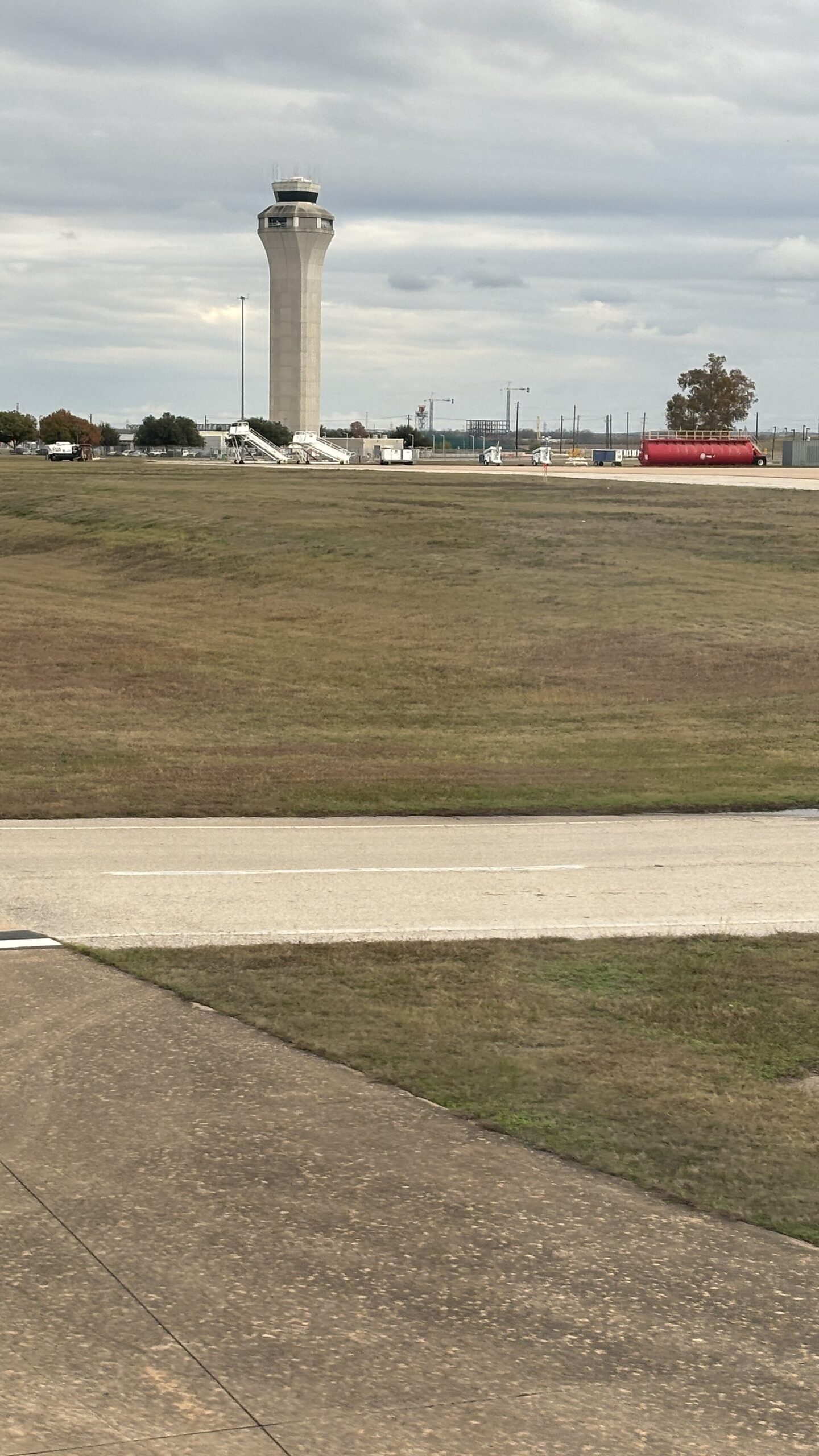
Control tower at Austin-Bergstrom International Airport. Source: Wikimedia Commons. CC0 public domain dedication.
Quick Answer
Austin-Bergstrom International Airport handled 16,526,244 passengers from January through September 2026, up 4.15% from the same months of 2025, according to the City of Austin Aviation Department’s latest monthly report. That rebound follows a slightly down 2025 and arrives as the airport builds an expansion that bond documents sized at $5.5 billion, about 83% of it to be financed with revenue bonds repaid from airline and passenger-related income rather than local taxes.
What Are the Key Facts About the Austin Airport Right Now?
Figures are as of November 15, 2026. The latest traffic report, released October 30, covers September 2026.
| Measure | Figure | Period covered |
|---|---|---|
| Total passengers | 1,817,572 (up 5.1%) | September 2026 |
| Total passengers, year to date | 16,526,244 (up 4.15%) | January-September 2026 |
| Total passengers, full year | 21,666,852 (down 0.44%) | Calendar 2025 |
| Air cargo, year to date | 201,934,953 pounds (down 1.73%) | January-September 2026 |
| Expansion program size | $5.5 billion | As reported at the April 2026 bond sale |
| Revenue bonds sold | $1.18 billion | Sale announced complete May 6, 2026 |
| Additional bonds planned | About $4.2 billion | Through 2030 |
| New gates planned | 32 (26 in Concourse B, 6 in Concourse M) | Per January 2026 airline agreements |
| Jobs supported | More than 74,000 direct and indirect | Airport figure cited in October 2026 |
How Busy Is the Austin Airport in 2026?
Busier than last year, and by a consistent margin. The Aviation Department counted 1,817,572 arriving and departing passengers in September 2026, a 5.1% increase over September 2025. Enplanements, or departing passengers, rose 5.79% to 903,881. July 2026 was the second-busiest month in the airport’s history at 2,102,655 passengers, up 3.27% from July 2025.
Through nine months, passenger traffic stood at 16,526,244, up 4.15%, and enplanements reached 8,255,726, up 4.02%. Aircraft operations rose 5.11% to 205,560.
Is 2026 on pace to beat 2025?
The year-to-date trend points that way, although the final three months have not been reported. Calendar 2025 closed with 21,666,852 passengers, down 0.44% from 2024, which the airport described as its third-busiest year. To match that total, the airport would need about 5.14 million passengers across October, November and December 2026. That is subtraction, not a forecast.
Which Airlines Carry the Most Passengers at AUS?
Four carriers account for roughly 88% of Austin’s passengers. The share column below is this publication’s calculation from the Aviation Department’s January-September 2026 airline totals; the growth column is the department’s own year-over-year comparison.
| Airline | Passengers, Jan-Sept 2026 | Change vs. Jan-Sept 2025 | Calculated share |
|---|---|---|---|
| Southwest Airlines | 6,888,901 | Up 6.3% | 41.7% |
| Delta Air Lines | 3,168,527 | Up 13.2% | 19.2% |
| American Airlines | 2,317,627 | Down 10.9% | 14.0% |
| United Airlines | 2,155,606 | Up 8.9% | 13.0% |
| Alaska Airlines | 494,649 | Down 6.6% | 3.0% |
| Frontier Airlines | 398,927 | Up 3.7% | 2.4% |
| British Airways | 208,739 | Up 10% | 1.3% |
| JetBlue Airways | 199,267 | Up 205.8% | 1.2% |
Who is gaining and who is losing ground?
Delta is the clearest gainer among the large carriers. Its Austin traffic grew 14.9% in calendar 2025 and another 13.2% in the first nine months of 2026. Southwest, which slipped 0.8% in 2025, is growing again, with September 2026 traffic up 10.9% from a year earlier. United is up 8.9% year to date.
American is the main decliner. Its Austin passenger count fell 17.9% in 2025 and is down 10.9% so far in 2026, though the September decline narrowed to 1.5%. Among smaller carriers, Spirit is down 49.9% year to date and Allegiant is down 19.1%.
What new routes have been announced?
Three announcements landed in the past six weeks, all for 2027 service:
- Southwest announced on October 2, 2026 that it will fly nonstop to Nassau, Punta Cana and Liberia, Costa Rica, twice weekly on weekends from June 3 through August 2, 2027.
- Alaska announced on October 27, 2026 a Saturday seasonal flight to Anchorage from June 12 through August 7, 2027, which the airport called its first domestic nonstop to Alaska.
- Delta announced on November 3, 2026 daily service to Northwest Arkansas National Airport starting March 7, 2027.
What Is Happening With Air Cargo?
Cargo is the soft spot. Total air cargo was 23,684,083 pounds in September 2026, down 3.52%, and 201,934,953 pounds year to date, down 1.73%. That follows an 8.45% decline for all of 2025, when the airport handled 276,375,963 pounds.
The decline is concentrated in one carrier. Air Transport International, the largest cargo operator at the airport, moved 67,955,604 pounds through September, down 15.4%. Federal Express was up 3.3% at 36,402,372 pounds, United Parcel Service was up 4.9% at 23,848,853 pounds, and Sun Country Airlines’ cargo volume rose 45.5% to 27,171,466. Belly freight carried on passenger aircraft rose 2.75% to 28,813,042 pounds.
What Is the Journey With AUS Expansion Program?
Journey With AUS is the public name for the Airport Expansion and Development Program. The airport says the Barbara Jordan Terminal was designed for 11 million annual passengers and can serve about 15 million today, against more than 21 million actually handled in 2025. The program’s centerpiece projects, as described in the airport’s January 2026 announcement and its program materials, are:
- Concourse B and Tunnel: a midfield concourse with 26 gates, linked to the existing terminal underground. Southwest is the anchor tenant with 18 gates, United takes 5, and 3 are common-use.
- New Arrivals and Departures Hall: expanded ticketing, a centralized security checkpoint, larger baggage claim and a redesigned curb.
- Concourse M: six gates reached by bus from the main terminal, intended to add capacity and absorb diverted and off-schedule flights.
- Concourse A redevelopment: modernization of the existing concourse, where Delta will anchor with 15 gates, American will hold 9, Alaska 1, and 8 will be common-use.
- Supporting work: midfield taxiways, a central utility plant, campus-wide utilities, an integrated baggage system and a roughly 7,000-space garage.
How much do the individual projects cost?
The airport’s program page lists the following budgets. Statuses there may lag recent milestones; figures are as published when reviewed November 15, 2026.
| Project | Listed cost | Listed completion |
|---|---|---|
| Concourse B and Tunnel | $72 million design; $1.031 billion pre-construction and construction | Early 2030s |
| New Arrivals and Departures Hall | $45 million design; $820 million pre-construction and construction | Early 2030s |
| New Midfield Taxiways | $26.7 million design; $320 million pre-construction and construction | 2027 |
| Integrated Baggage Handling System | About $300 million | With Concourse B and the new hall |
| Yellow Garage | $15 million design; $250 million pre-construction and construction | Early 2027 |
| West Gate Expansion (3 gates) | About $165 million | Estimated 2026 |
| West Infill, outbound baggage system and international arrivals package | About $241 million combined | Complete (2025-2026) |
What is the most recent construction milestone?
On October 19, 2026 the airport broke ground on the Utilities Infrastructure Campus-Wide project, which it described as the start of the program’s next major phase. The work covers stormwater lines and ponds, redundant medium-voltage power and telecommunications duct banks that support the utility plant, the new hall and Concourse B. Design began in 2024 and completion is expected in 2029. Sundt Archer Western is prime contractor and HDR is designer; the project draws about $10.1 million from the Federal Aviation Administration’s Airport Infrastructure Grants program and about $6.1 million from its Airport Improvement Program.
How Is the Expansion Being Paid For?
Mostly with debt backed by the airport’s own revenue. The airport states that no local Austin taxpayer dollars fund the program; its sources are cash reserves, current and future airport revenues, revenue bonds and FAA grants.
The financing took shape in three steps. On August 28, 2025 the Austin City Council authorized staff to finalize a long-term agreement with airlines. On January 7, 2026 the city announced that Southwest, Delta, United, American and Alaska, along with cargo operators FedEx and UPS, had signed Airline Use and Lease Agreements and Signatory Cargo Agreements carrying a 10-year operating commitment, effective January 1, 2026. That announcement put the expected budget at more than $5 billion for 32 gates, up from an estimated $4 billion for 20. Then, on May 6, 2026, the airport announced it had completed a $1.18 billion Airport System Revenue Bond sale, which it called the largest in the history of the airport and the City of Austin.
What did the bond documents reveal?
The Bond Buyer’s April 14, 2026 report on the offering supplied the most detailed public numbers on the plan:
- The capital program was sized at $5.5 billion, with about 83% expected to be bond-financed, 4% from federal grants and 3% from passenger facility charges.
- Ratings were A1 from Moody’s, A-plus from S&P and AA-minus from KBRA, each with a stable outlook, on a first lien on net airport system revenue.
- About $4.17 billion of further issuance was expected over the following four years.
- Enplanements were forecast to grow from 11.3 million in fiscal 2026 to 16.7 million in fiscal 2033, with airline and non-airline revenue rising from nearly $432 million to $982 million.
- Projected debt service coverage peaks at 3.13 times and declines to 1.66 times; airlines committed to rates producing at least 1.4 times.
- About 89% of Austin’s passengers begin or end their trip in Austin rather than connecting.
How much federal money is involved?
Federal grants are a small slice, about 4% of the plan per the bond report. Known awards include $33.27 million announced in October 2024 from the FAA’s Airport Terminal Program for Concourse B, bringing that project’s total from the program to $47.62 million, plus the roughly $16.2 million in two FAA grants for the utilities project.
What Does the Airport Mean for the Central Texas Economy?
The airport says it supports more than 74,000 direct and indirect jobs in Central Texas and that it first reached the FAA’s large-hub classification in 2022. In an October 29, 2026 notice to prospective vendors, it said airline seats at Austin have risen 39% since 2019 against an industry average of 5%, making it the fourth-fastest-growing large or medium hub in the country.
The same notice outlined business opportunities. The expansion is to add more than 70,000 square feet of retail, dining and passenger amenities. The airport expects to issue two to three requests for concession proposals over three years, the first in early 2027 for Concourse B.
Brian’s Take
I read this as a financing story more than a construction story. The airport sold $1.18 billion of bonds in the spring and has told the market it expects to borrow roughly $4.2 billion more through 2030. With about 83% of a $5.5 billion program resting on debt, the thing I would watch is not the renderings but the passenger count, because passengers and the airlines that carry them are what repay those bonds.
On that score, the 2026 numbers are encouraging but not a blank check. Traffic is up 4.15% through September after a flat-to-down 2025. The forecast behind the bonds has enplanements climbing from 11.3 million to 16.7 million by fiscal 2033. That is a lot of growth to assume, and American’s two-year pullback shows that volume from a single airline can fall quickly. To me, the offsetting fact is that five airlines signed 10-year commitments and that 89% of passengers are local demand, not connections an airline can reroute.
For Texas business, I think the practical takeaway is concentration and cost. Southwest carries about four in ten Austin passengers and will anchor the new concourse. The bonds are repaid from what airlines and travelers pay the airport, so in my view employers who depend on air access have a direct stake in how those costs are shared.
Frequently Asked Questions
How many passengers used the Austin airport in 2025?
The airport reported 21,666,852 passengers in calendar 2025, down 0.44% from 2024 and its third-busiest year on record.
How many new gates is Austin-Bergstrom adding?
The January 2026 airline agreements describe 32 new gates: 26 in the midfield Concourse B and 6 in Concourse M. The West Gate Expansion separately adds three gates to the existing terminal.
When will Concourse B open?
The airport’s published estimate is the early 2030s for Concourse B, its tunnel and the new Arrivals and Departures Hall. No specific opening date has been announced.
Are Austin taxpayers paying for the airport expansion?
The airport says no local Austin taxpayer dollars are used. Funding comes from airport cash reserves, airport revenues, revenue bonds, passenger facility charges and FAA grants, and the bonds are repaid from airport operating revenue.
Which airline is the largest at AUS?
Southwest Airlines, with 6,888,901 passengers from January through September 2026, about 41.7% of the airport’s total by this publication’s calculation. Delta is second at about 19.2%.
Sources and Further Reading
- September 2026 Passenger, Cargo Traffic at Austin-Bergstrom International Airport – City of Austin Aviation Department
- July 2026 Passenger, Cargo Traffic at Austin-Bergstrom International Airport – City of Austin Aviation Department
- AUS December 2025 Passenger Traffic and Year-End Numbers – City of Austin Aviation Department
- Austin-Bergstrom International Airport and Airline Partners Finalize Historic Use and Lease Agreements – City of Austin Aviation Department
- AUS Secures $1.18 Billion in the Largest-Ever City of Austin Bond Sale to Support Airport Expansion – City of Austin Aviation Department
- Austin to Sell $1.18 Billion of Revenue Bonds for Airport Expansion – The Bond Buyer
- Austin-Bergstrom International Airport Begins Construction on Utility Infrastructure Campus-Wide Project – City of Austin Aviation Department
- Journey With AUS program page and February 2026 one-page summary – City of Austin Aviation Department
- Austin-Bergstrom International Airport Invites Local Businesses to Explore Concessions Opportunities – City of Austin Aviation Department
- Southwest, Alaska and Delta new route announcements, October-November 2026 – City of Austin Aviation Department
- Austin City Council airline lease agreement coverage, September 2025 – Austin Monitor and KUT
- Austin-Bergstrom’s Concourse B Project Awarded $33.27 Million from Bipartisan Infrastructure Law – AviationPros